
The Real Money Behind STRATOS: O’Leary Ventures Pegs Phase 1 at more than $4 Billion, with $20 Billion of Expenditures in its Early Phases

New figures from O’Leary Ventures' CEO, Paul Palandjian, show the massive Box Elder County, Utah AI data center campus is financially far larger than the $1 billion figure reported locally.
7 May 2026 — Box Elder County, Utah — So far, the public debate over STRATOS has centered on water, power, emissions, land use, tax incentives, local control, and whether western Box Elder County should become home to one of America’s largest artificial intelligence infrastructure campuses.
All of those questions matter, but it appears the money story may have been significantly underreported locally.
STRATOS, the proposed 40,000-acre hyperscale data center and power-generation project tied to O’Leary Digital, has been described in at least one local report as a $1 billion project.
That number now appears to be materially incomplete.
In recent public comments, Kevin O’Leary (aka, "Mr. Wonderful") framed Utah as unusually fast-moving in the global race to build artificial intelligence infrastructure.
“What’s extraordinary about Utah is I heard about this opportunity just five months ago,” O’Leary said. “That’s it, and here we are on the cusp of doing something absolutely phenomenal together,” according to Deseret News reporting on his appearance before the Military Installation Development Authority.
{NOTE: MIDA is "... a State of Utah entity created in 2007 to further economic development across multiple jurisdictions, bringing together private and public enterprise and promoting military initiatives."}
Continuing with Mr. Wonderful's statement ...
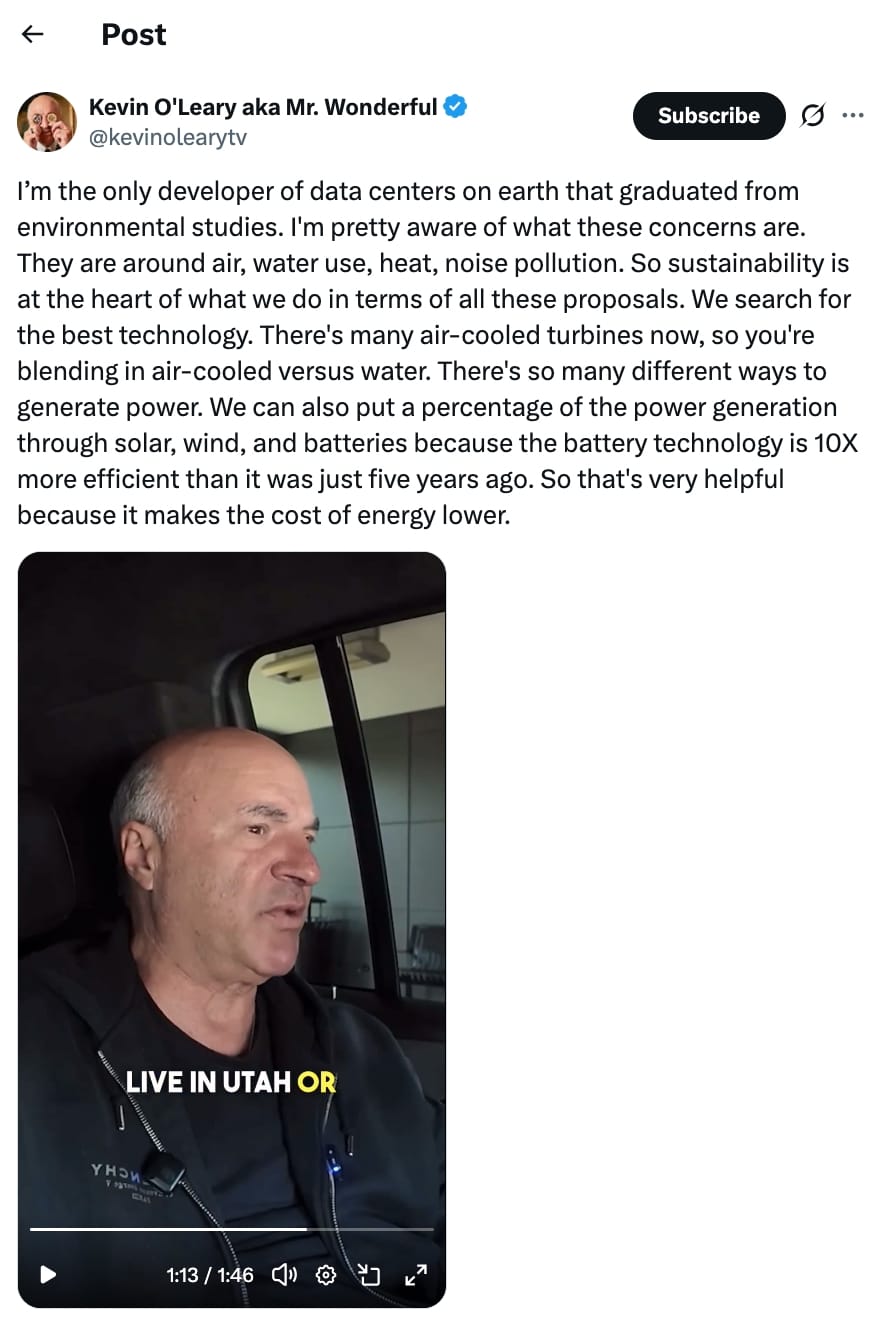
That “something” is now being framed by O’Leary Ventures as far larger than a $1 billion data center.
In an exclusive statement provided directly to Utah Money Watch, Paul Palandjian, CEO of O’Leary Ventures, said STRATOS's first phase alone is expected to represent more than $4 billion of investment in Box Elder County.
“It is estimated that on the Phase One, 500mw project (of STRATOS), we will see a more than $4 billion investment in Box Elder County representing a transformational opportunity for Utah.
“We will be scaling to 3GW in early phases with a total of $20B investment, strengthening our tax base, creating high-quality jobs, supporting long-term infrastructure investment, and positioning rural Utah as a national leader in next-generation technology and data innovation.
“This is the single largest one-time investment in Utah’s history ... and in one of our rural communities.”
That quote changes the frame.
This is no longer simply a data center story; it is a multibillion-dollar AI infrastructure, rural economic-development, power-generation, and tax-base story.
Why the $1 Billion Figure Needs Clarification
After the 4 May 2026 Box Elder County Commission vote, KSL.com reported that Casey Hill, identified as an O’Leary spokesman, said the project would be completed in phases at “an estimated price tag of $1 billion.”
The same story reported that the county vote would allow “redoubled capital-raising efforts” within 60 days.
That $1 billion figure has now become one of the most important numbers in the public discussion locally.

And yet, based on what representatives of O’Leary Digital told Utah Money Watch, that $1 billion amount should not be treated as the all-in cost of STRATOS.
Those representatives said the company expects to spend upward of $1 billion for preparatory work alone to ready the Box Elder County land for Phase 1 buildout.
That distinction is critical, as clearly a $1 billion figure is substantial.
But a $1 billion site-preparation effort, followed by a more-than-$4-billion 500-megawatt Phase 1, followed then by early-phase scaling to 3GW (gigawatts) at a cost approaching $20 billion, is something else entirely.
Such information places STRATOS in the category of Utah mega-projects, not ordinary economic development.
The Novva Corollary
The financial scale becomes more understandable when compared with another Utah hyperscaler data center project.
In March 2025, The Wall Street Journal reported that CIM Group and South Jordan, Utah-headquartered Novva Data Centers had secured a $2 billion construction loan from JPMorgan Chase and Starwood Property Trust to build a 100-acre AI data center campus in West Jordan, Utah capable of providing 175 megawatts of continuous service.

That corollary is not a perfect "apples to apples" comparison as STRATOS is obviously
- A different project,
- In a different county,
- On a vastly larger land base, with
- Its own on-site power-generation strategy.
But the benchmark is useful from a comparative standpoint.
A $2 billion construction loan for a 175-megawatt Utah data center campus helps explain why a 500-megawatt first phase for STRATOS could reasonably exceed $4 billion, especially if major power, site, utility, transmission, road, grading, security, and support infrastructure must be built into the front end.
When one does the math, on a rough megawatt basis, the Novva Data Centers financing equates to about $11.4 million per megawatt of continuous service.
Applied to a 500WW project (the equivalent of what is planned for Phase 1 of STRATOS), that would imply roughly $5.7 billion in expenditures.
Understandably, that is not a valuation model but rather a sanity check.
It also suggests the new O’Leary Ventures figures are more consistent with hyperscale AI infrastructure economics than the simplified $1 billion narrative.
STRATOS is Also a Power Project
The second misconception involves how STRATOS would be powered.
The public shorthand has often treated STRATOS as a massive data center project. While a true statement, it is also incomplete.
STRATOS is better understood as an integrated data center and energy campus.
The Salt Lake Tribune has reported that the development agreement allows O’Leary Digital to work with Tallgrass Energy for natural gas utility service through a connection to the Ruby Pipeline, with the project using that gas to generate its own power.
Separately, Axios Salt Lake City reported that the project would receive a reduced energy tax rate through MIDA, with state officials framing the project around economic development and U.S. competitiveness in artificial intelligence.
And the Deseret News has reported that STRATOS would sit on 40,000 acres in western Box Elder County and include plans for 7.5 gigawatts of power development. It also noted that O’Leary Ventures’ Canadian Wonder Valley project has been described as a $70 billion development in Alberta.
Those numbers make clear that STRATOS is not merely asking whether Utah has enough power for another data center.
Instead, that information asks whether Utah should host a new kind of AI infrastructure model, one in which compute capacity and power generation are developed together.
On the one hand, supporters see private investment, rural tax-base expansion, construction jobs, permanent jobs, infrastructure upgrades, and a chance to position Utah inside the next generation of AI infrastructure.
Conversely, opponents see water risk, emissions risk, noise, heat, Great Salt Lake concerns, land-use disruption, tax concessions, and a public-approval process they believe moved too fast.
Both sides are obviously reacting to the same underlying reality:
The STRATOS plans are enormous.
What Box Elder County Approved
On 4 May, the three-member Box Elder County Commission voted unanimously to allow the STRATOS project area to move forward through an agreement involving MIDA.

That said, the approval does not mean bulldozers begin full construction immediately.
Major details remain unresolved or not fully public, including
▪️ Final financing,
▪️ Tenants,
▪️ Full power-generation plans,
▪️ Environmental permitting,
▪️ Water strategy,
▪️ Buildout timing, and
▪️ Whether opponents choose to pursue
— Legal,
— Regulatory, or
— Referendum challenges.
In other words, the financial story is still unfolding.
But the approval has moved STRATOS beyond the proposal stage into the development stage.
And with the new figures Palandjian provided to Utah Money Watch, the platform looks much larger than many Utahns may have understood.
The "Poppa P" Perspective
From my perspective, the STRATOS story should not be framed primarily as whether Kevin O’Leary is bringing a $1 billion data center to Utah, as such financial framing is both too small and incomplete.
The better framing is this:
O’Leary Ventures has now described STRATOS as
🔹 A more-than-$4-billion Phase 1 investment, with
🔹 $20 billion in early-phase investment expectations, tied to
🔹 Scaling from 500 megawatts to 3 gigawatts, with
🔹 Representatives saying upward of $1 billion may be spent just preparing the land for full buildout.
That is the money story.
However, it's clear that this story is also not complete, as
- The controversy remains real,
- The environmental questions are serious,
- The tax-incentive questions will be scrutinized, and
- The opposition should not be dismissed as noise (whether it is drive purely by Utah citizens or includes outside agitators).
But Utahns cannot evaluate STRATOS accurately if the capital scale is misunderstood.
As such, if the numbers now provided by O’Leary Ventures are realized, STRATOS would not be just a large rural project.
It would be a defining Utah infrastructure bet, arguably the largest single development project in the state. Ever.
The implications, then, are no longer whether Box Elder County wants a data center.
The questions are whether Utah is ready to become a frontier market within the United States for the physical backbone of artificial intelligence, including the
🔺 Land,
🔺 Gas,
🔺 Power,
🔺 Capital,
🔺 Public authority, and (the potential)
🔺 Controversy
required to build it.
Stay tuned.
Publisher's Note
This writeup was originally published and distributed to our Subscribers at approximately 09:50am MT on Thursday, 7 May 2026.
However, if this report/article came to your attention sometime after this date/time and you'd like to change that, then (to become a subscriber), please
1. Click on a "Subscribe" button on any Utah Money Watch webpage (visit www.UtahMoneyWatch.com),
2. Enter in your name in the proper field in the popup window that appears on-screen, and
3. Enter your preferred email address in the proper field too.
That's it. Thanks.
Team Utah Money Watch


Comments ()