
NYSE-Listed Granite Deepens Utah Bet with Acquisition of Provo-Based Kenny Seng Construction
A publicly traded infrastructure giant adds a Utah construction and aggregates platform generating roughly $150 million in annual revenue, as national firms increasingly build long-duration operating positions inside Utah’s expanding economy.
29 April 2026 — WATSONVILLE, Calif. and PROVO, Utah — A publicly traded California infrastructure giant is making a deeper long-term commitment to Utah.
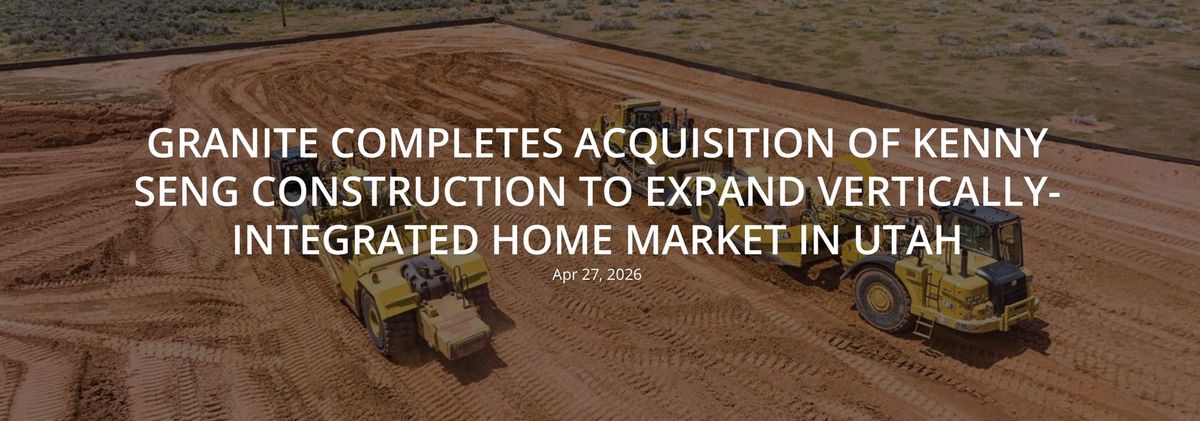
Specifically, Granite Construction Incorporated (NYSE: GVA) has completed its acquisition of Kenny Seng Construction, a Provo-based civil construction, aggregates, and infrastructure company with roughly $150 million in annual revenue and operations tied to public infrastructure, private development, and materials production across Utah.

As noted in the Granite news release, terms of the acquisition were not disclosed.
From my perspective, however, the more important story may not be the missing purchase price.
Instead, the larger signal may be what this transaction says about how national infrastructure firms increasingly view Utah itself.
Specifically, this does not appear to be a case of a company merely chasing projects inside a fast-growing Western state.
Rather, firms like Granite increasingly appear to be building durable operational positions designed to participate in Utah’s long-term physical and economic expansion for years to come.
That distinction matters.
Utah Is Increasingly Becoming a Strategic Operating Geography
I suspect that few Utahns recognize the Granite name.
Even so, the Watsonville, California-based company is already deeply involved inside Utah’s infrastructure economy.
For example, over roughly the past two years, Granite has announced multiple Utah transportation and infrastructure awards tied to the Utah Department of Transportation, including:
- A $65 million SR-30 improvement project in Logan,
- A $111 million transportation project in Salt Lake City, and
- A bridge replacement project in Riverdale.
The company also already maintains Utah operations in Salt Lake City.
And Granite is currently valued at $5.5 billion on $4.4 billion in revenue over the past 12 months.

Viewed independently, the Kenny Seng acquisition may initially appear straightforward — one construction company buying another.
But once layered into the broader economic realities reshaping Utah for the past two decades, the transaction begins to look more consequential.
Specifically, Utah increasingly appears to be evolving from a regional growth state into a strategically important Intermountain operating geography where national firms want:
- Deeper infrastructure presence,
- Tighter supply-chain control,
- Stronger materials access,
- More dense operating capability, and
- Longer-duration positioning.
That is materially different from simply winning projects.
Utah’s Growth Is Increasingly Corridor-Constrained
For a variety of reasons, Utah’s growth is also unusually compressed geographically.
Although the state’s population is now close to 3.5 million residents, with most of that centered along a 125-mile stretch of the Interstate-15 corridor (from Santaquin on the south to Brigham City on the north), with its connected transportation arteries, including:
- Interstate-215,
- Bangerter Highway,
- Legacy Highway, and the
- Mountain View Corridor,
with I-15 bifurcated by Interstate-80 in northern Salt Lake County.
That matters because these routes are not merely transportation systems. Rather, they are growth infrastructure, and they help shape where
- Housing expands,
- Industrial development occurs,
- Utilities must be extended,
- Commercial activity clusters,
- Transportation demand intensifies, and
- Construction materials and infrastructure services become strategically valuable.
At the same time, Utah continues operating inside a uniquely constrained physical-growth environment.
State residents understand that the Wasatch Mountain Range borders much of the state’s primary population corridor to the east, while the Great Salt Lake, Utah Lake, and Oquirrh Mountains constrain significant portions of the western side of the Wasatch Front as well.
Separately, a significant majority of Utah’s total land base remains controlled by either the federal government or the State of Utah itself.
Taken together, those realities create a different kind of economic environment for Utah, making it a fast-growing state with increasingly concentrated
- Infrastructure,
- Land-use,
- Transportation, and
- Development pressure.
And in that context, Granite’s acquisition of Kenny Seng Construction begins to look less like a simple contractor acquisition and more like a strategic operating-position expansion inside one of the country’s more structurally constrained growth corridors.
The “Vertically Integrated” Language Matters
Importantly, Granite did not merely acquire additional construction crews or project backlog.
According to the company announcement, the acquisition adds:
- Aggregate and quarry operations,
- Roughly 45 million tons of reserves/resources,
- Annual production potential approaching 1 million tons,
- Utility installation capability,
- Site preparation operations,
- Concrete work,
- Transportation infrastructure expertise, and
- Broader civil-construction capacity.
That “vertically integrated” wording inside the announcement matters because sophisticated infrastructure firms increasingly seek operational control around projects, not simply project participation itself.
In practical terms, that can include:
- materials sourcing,
- logistics positioning,
- transportation proximity,
- labor density,
- margin protection,
- and regional operating efficiency.
Utah increasingly appears economically important enough to justify that kind of deeper capital and infrastructure commitment.
The Aggregates Story Is Bigger Than Many Readers Realize
One of the most overlooked parts of this transaction may actually be the aggregates and materials component.
Aggregate, gravel, rock, and related construction materials rarely generate major public attention. Nevertheless, they remain foundational to nearly every layer of physical economic expansion.
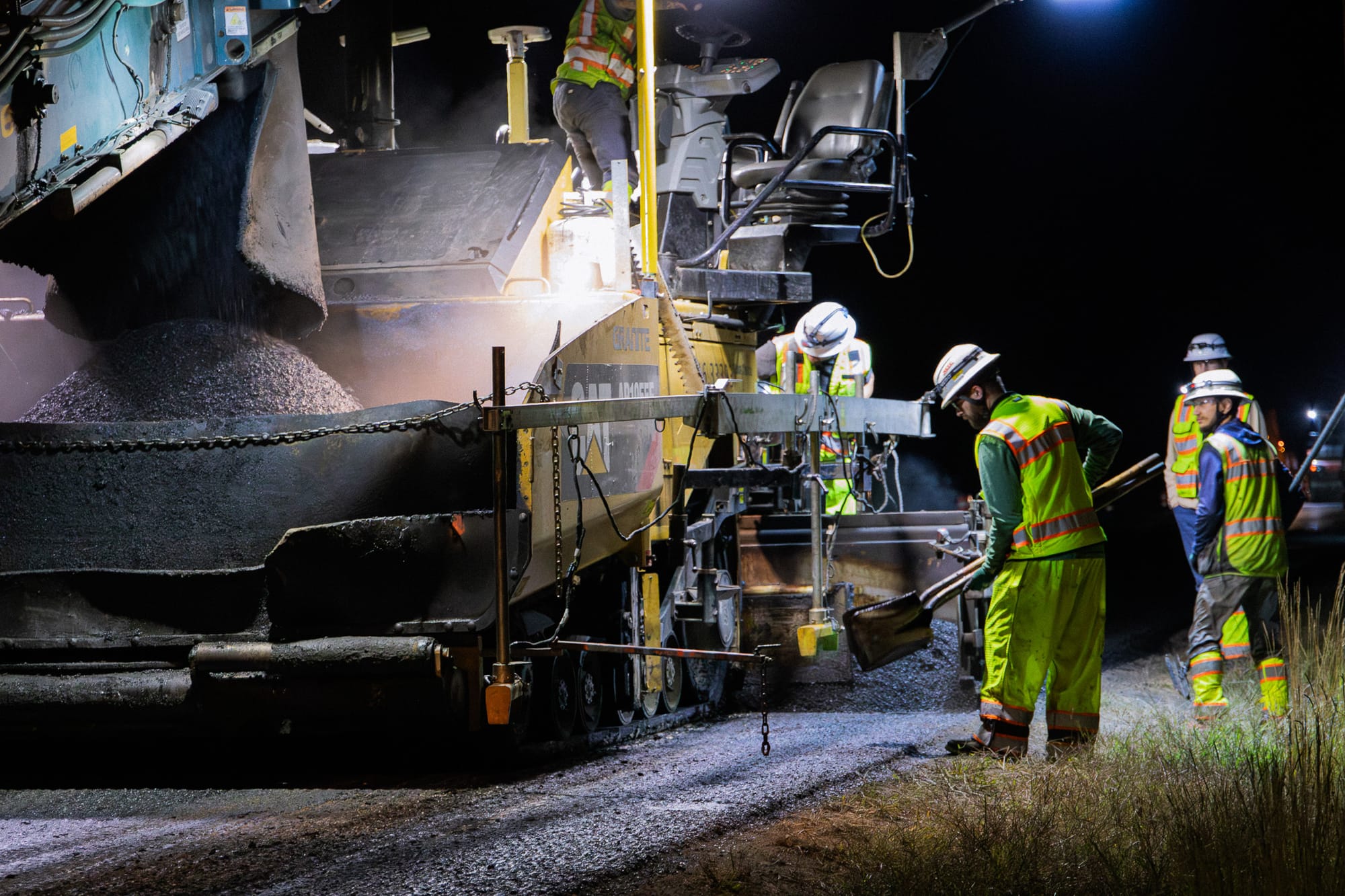
Specifically, aggregates are needed for
- Roads,
- Subdivision development,
- Commercial expansion,
- Utility corridors,
- Industrial growth
and more.
That matters because fast-growing states do not merely require more buildings.
They require more of the underlying systems supporting those buildings.
And increasingly, Utah’s growth story is not only about software, venture capital, healthcare, artificial intelligence, fintech, and professional services expansion.
It is also about:
- Roads,
- Utilities,
- Industrial infrastructure,
- Transportation systems,
- Distribution corridors,
- Power demand,
- Site preparation, and
- The monetization of physical growth itself.
That is where this transaction becomes more interesting.
Utah’s Infrastructure Economy May Be Entering a Different Phase
To me, the deeper interpretation here is that Utah’s infrastructure economy increasingly appears to be entering a different stage of maturity.
Early-stage growth markets often attract outside firms looking for project opportunities. Conversely, more mature growth markets increasingly attract firms seeking operational permanence.
Clearly, those are different things as
- Project participation can be temporary, while
- Platform positioning is usually long-term.
And this Granite/Seng transaction increasingly appears closer to the second category.
That distinction also helps explain why this acquisition matters even without a disclosed purchase price.

Because the more important signal may be the operational logic behind the acquisition itself:
- Long-duration Utah growth,
- Continuing infrastructure expansion,
- Population pressure,
- Transportation demand,
- Utility-system expansion, and
- Deeper regional construction/materials needs.
Once assembled together, those forces create a more meaningful picture than any individual project announcement alone.
The Poppa P Perspective
Viewed one transaction at a time, deals like this can appear fragmented:
- A road contract here,
- A quarry acquisition there,
- A bridge project elsewhere.
But once the pieces are assembled together, a different pattern comes increasingly into view.
From my perspective, it's not that national firms are not pursuing Utah projects.
In fact, it appears that they are beginning to build Utah operating platforms.
If true, this viewpoint may become one of the more important long-term financial stories inside Utah’s broader economy over the next decade.
So congrats to Kenny Seng Construction and Granite.
Publisher's Note
This writeup was originally published and distributed to our Subscribers at approximately 07:25am MT on Wednesday, 29 April 2026.
However, if this report/article came to your attention sometime after this date/time and you'd like to change that, then (to become a subscriber), please
1. Click on a "Subscribe" button on any Utah Money Watch webpage (visit www.UtahMoneyWatch.com),
2. Enter in your name in the proper field in the popup window that appears on-screen, and
3. Enter your preferred email address in the proper field too.
That's it. Thanks.
Team Utah Money Watch


Comments ()