
The U.S. Army has Begun Exclusive Negotiations to Finalize Plans for Two Firms to Process Critical Minerals at Tooele Army Depot in Tooele County, Utah
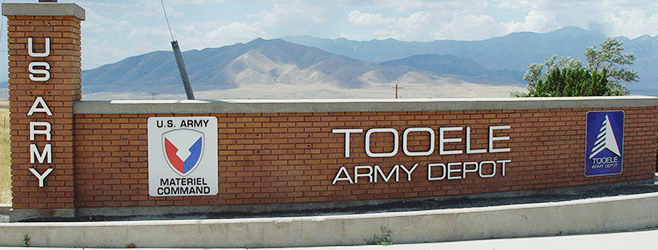
Executive Summary: Two firms (one from Boca Raton, Florida and one from Sydney, Australia) have been conditionally selected by the U.S. Army "to design, finance, build, and operate critical mineral processing facilities on underutilized land on Army installations ..." to process and refine boron, dysprosium (Dy), and terbium (Tb) in Utah on Tooele Army Depot land.
Final contract negotiations are underway.
29 June 2026 — TOOELE COUNTY, Utah — The U.S. Army has awarded conditional, long-term enhanced use leases (EULs) to four firms with an eye toward processing so-called critical minerals on underutilized land on three domestic Army installations, one of which is Tooele Army Depot in Tooele County, Utah.
As noted in the Army's announcement, the intent of the leases (when finalized) is "... to establish domestic processing capacity for minerals foundational to the warfighting capability of the Joint Force."
Final contract negotiations are underway, the Army release states.
Two of the four firms were selected for possible work at Tooele Army Base, specifically:
🔺 Sydney, Australia-based Ioneer (ASX:INR) and (NASDAQ:IONR), which has been selected to process boron on-site into defense-grade boron carbide (B₄C) and high-purity boron compounds, some of which are used as propellent initiators for artillery, mortars, medium caliber ammunition, grenades, bombs, etc.; and
🔺 Boca Raton, Florida-headquartered REalloys (NASDAQ:ALOY), which has been selected to refine heavy rare earths, including dysprosium (Dy) and terbium (Tb), both of which are "... used to manufacture high-performance permanent magnets that can withstand extreme operational temperatures ... in precision-guided munitions, electric motors, and sonar and radar networks."
As stated in the U.S. Army release:
"These (lease) awards are the first time the Army / Dept. of War has sited commercial mineral processing facilities on American military installations, a direct execution of President Trump’s Executive Order 14241."
Introducing Ioneer and REalloys
For readers not familiar with the company, Ioneer traces its history back nearly 25 years when it began as a mineral exploration firm.
In January 2025, Ioneer announced it had landed a $996 million loan from the U.S. Department of Energy to"... support the development of an on-site processing facility at the Rhyolite Ridge Lithium-Boron Project in Esmeralda County, Nevada."

The company also announced in its first quarter results filing (ended 31 March 2026) that it had
🔹 Closed a $50(US) million private equity placement in Q1 2026, and that it
🔹 Has engaged Goldman Sachs to "assist Ioneer with (its) strategic partnering process."
Separately, REalloys describes itself as "... a U.S.-based rare earth materials company executing a mine-to-magnet strategy across upstream feedstock, midstream separation and metallization, and downstream magnet manufacturing."
As stated in its June 25 news release last week, REalloys said it:
"... intends to refine dysprosium (Dy) and terbium (Tb) — heavy rare earth elements (on Tooele Army Depot land) that are indispensable to precision guidance and defense electronics. These materials are used to manufacture high-performance permanent magnets capable of withstanding extreme operational temperatures, the kind found in precision-guided munitions, electric motors, and sonar and radar networks."

Additionally, the day after the Army and REalloys distributed their releases about the conditional, long-term enhanced use leases, REalloys announced that it had closed a $100 million private placement funding round.
Not Land Purchases, but Leases with Benefits.
As explained in its announcement, the U.S. Army acts as landlord, while its partners (in the case of Tooele Army Depot — REalloys and Ioneer) "... bear all costs to finance, design, build, operate, secure, and decommission the (facilities)."
The Army release also explained that for lease agreements, like those in final negotiations with Ioneer and REalloys, the lessee(s)
✅ "... pay rent at or above fair market value ..." and
because the Army prefers to receive "in-kind payments,"
✅ Lessees typically "... fund and execute infrastructure improvements on the host installation(s) ..."
The Army claims in its announcement that taking this approach "directly benefits Soldiers, families, and operations by upgrading utilities, enhancing infrastructure, and modernizing mission capabilities."
Lessees are also required to lock-down
"... mandatory decommissioning bond(s) to ensure that funds are secured well in advance to return the land to its original condition when the lease(s) end."
Finally, the Army release stated that:
"No construction will begin until rigorous environmental and regulatory reviews—including the National Environmental Policy Act (NEPA), Clean Air and Water Acts, and all required federal, state, and local permits—are fully complete."
In connection with its agreement with the U.S. Army, REalloys CEO, Leonard "Lipi" Sternheim, said:
"This partnership represents a historic step for assuring these materials are domestically sourced and fully compliant for weapon system integration. We look forward to supporting the Army in such an important leadership initiative to enable warfighter readiness and the mission effectiveness of our future fighting force.”
Separately, Bernard Rowe, Managing Director and CEO of Ioneer, said:
"Boron is foundational to modern military power and force protection – and producing it on America soil strengthens our industrial base while reducing our over-reliance on foreign sources. We look forward to advancing this partnership in direct support of the Joint Force and the warfighters who depend on these materials every day.”
A virtual tour of the Ioneer's Rhyolite Ridge Lithium-Boron Project plant, with an Engineering Model Rendering. Voiceover for the video is provided by Ioneer CEO, Bernard Rowe.
The "Poppa P" Perspective
Given the efforts of adversarial nations to maximize control of various rare earth minerals and metals, I'm not surprised that the U.S. government has authorized the buildout of processing and refinement plants on underutilized land on military installations.
In fact, Tooele Army Depot has been in the business of working with national defense minerals and elements throughout its over 80-year history.
{I know because my father-in-law, a civil engineer by training, helped build some of the facilities there after World War II.}
That said, these Tooele Army Depot lease agreements for processing critical minerals sure seem to be a pretty big deal to me and appear to be a further strengthening of the growing national defense ecosystem in Utah.
Obviously, "conditional" and "final" are very different terms.
As such, I plan to keep an eye out for news from the Army, REalloys, and Ioneer as to any change of status on these conditional EULs.
Publisher's Note
This writeup was originally published and distributed to our Subscribers at approximately 06:05pm MT on Monday, 29 June 2026.
However, if this report/article came to your attention sometime after this date/time and you'd like to change that, then (to become a subscriber), please
1. Click on a "Subscribe" button on any Utah Money Watch webpage (visit www.UtahMoneyWatch.com),
2. Enter in your name in the proper field in the popup window that appears on-screen, and
3. Enter your preferred email address in the proper field too.
That's it. Thanks.
Team Utah Money Watch

Comments ()