
Five Months After a $490 Million Refinancing, Utah’s Varex Imaging Agrees to be Acquired by Teledyne in a $1.1 Billion Deal

EXECUTIVE SUMMARY
✅ Salt Lake City-based Varex Imaging has agreed to be acquired by Teledyne Technologies for $18.90 per share in a cash transaction carrying an aggregate value of approximately $1.1 billion, including Varex equity awards and net debt.
✅ Based upon the 42.1 million Varex common shares outstanding as of 30 April 2026, the $18.90 acquisition price implies approximately $796 million in cash to be paid; in other words, the widely reported $1.1 billion figure is not the amount of cash being paid directly to Varex shareholders.
✅ It should also be noted that Varex agreed to sell itself less than five months after completing a $490 million refinancing that replaced higher-cost 2027 debt with cheaper financing extending into 2031.
✅ There is currently no evidence that the Varex refinancing was undertaken in preparation for a sale. But the forthcoming Proxy Statement filing with the SEC may tell us when acquisition discussions actually began and whether these two major capital events overlapped.
13 August 2026 — SALT LAKE CITY — Five months ago, Utah Money Watch reported that one of Utah's least-known public companies had quietly restructured nearly half a billion dollars of debt.
Now we know what's next.
Salt Lake City-based Varex Imaging has agreed to be acquired by Thousand Oaks, California-based Teledyne Technologies for $18.90 per share in cash, with the companies placing an aggregate value of approximately $1.1 billion on the transaction.
Both boards have unanimously approved the merger (which remains subject to Varex shareholder approval and regulatory clearances), but the acquisition is expected to close in early 2027.
If it does, Varex (NASDAQ:VREX) will become a wholly owned subsidiary of Teledyne and VREX shares will disappear from the Nasdaq Stock Market.
For Varex, however, the implications could be considerably larger:
Varex would go from operating as an $845 million-revenue standalone public company to becoming part of a global technology business nearly eight times its size.
$1.1 Billion, Yes. But Not to Shareholders.
To clarify what appears to have been some misunderstanding in the media, Teledyne is not paying Varex's common shareholders $1.1 billion.
Rather, the announcements from both companies (Varex and Teledyne) each describe the transaction as worth approximately $1.1 billion, but explicitly say that figure incorporates Varex's equity awards and net debt as of the 3rd of April.
Namely, as of 30 April 2026, Varex reported it had 42.1 million common shares outstanding. At $18.90 apiece, those shares carry an implied value of roughly $796 million.
So, no, Teledyne is not handing Varex's common shareholders $1.1 billion.
Instead, think of the $1.1 billion figure as something closer to the total economic price of acquiring the business, including common equity, equity awards and Varex's net indebtedness. Or more simply, its valuation.
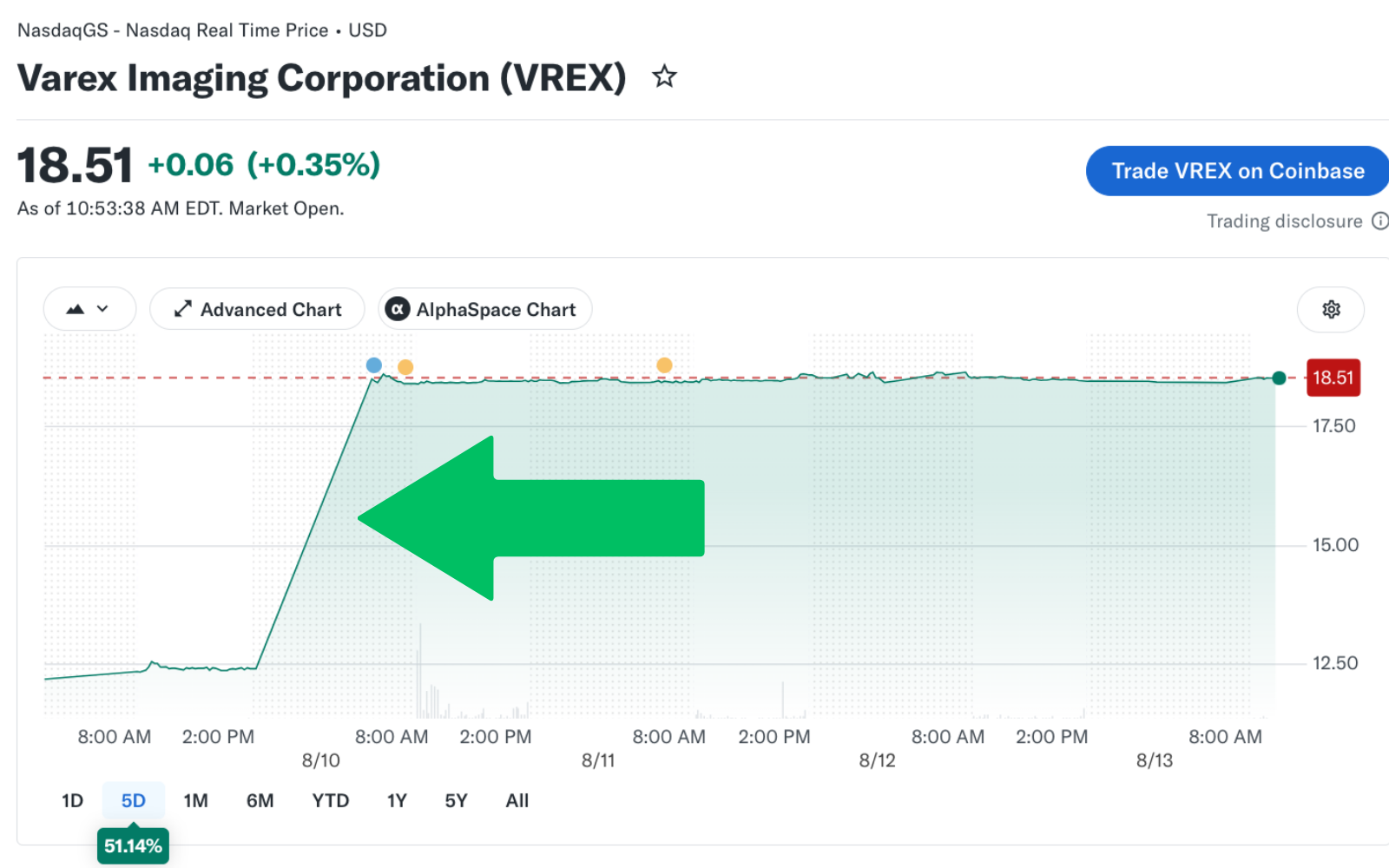
That said, the $18.90 offer price itself represents a hefty 52% premium to Varex's $12.41 closing share price on Friday, August 7, before the transaction became public the following Monday, something dramatically shown in the stock price lift-off on the day the acquisition was announced. (See below.)
It should be noted, however, the overall transaction value equals only about 1.3 times Varex's trailing annual sales of $844.6 million for fiscal 2025.
More Context with a Five-Month Look-Back
To view this week's announcement with a finer lens, it may be helpful to take a five-month retrospective on Varex's financial movements at the time.
Specifically, on 13 March 2026, Varex completed a complex $490 million refinancing as reported by Utah Money Watch here.
The package consisted of
⚫️ A $350 million term loan,
⚫️ A $100 million revolving credit facility, and
⚫️ A $40 million delayed-draw term facility,
each maturing in 2031.
Salt Lake City-based Zions Bancorporation served as lead arranger and sole bookrunner.
Varex then used the transaction to retire the remaining $368 million of its 7.875% Senior Secured Notes due in October 2027, absorbing refinancing-related costs while pushing its major debt maturity several years into the future.
According to the Utah Money Watch writeup, Varex
"... just reworked nearly half a billion dollars of financing in a way that appears intended to strengthen the company’s financial architecture."
Now, five months later, Varex is being sold.
TO BE CLEAR, this does not mean one transaction caused the other.
In fact, nothing disclosed publicly so far by either firm establishes that Varex refinanced because Teledyne, or anyone else, was preparing to buy the company.
But chronology is important, and as such, this is my question:
When did Varex begin exploring a sale?
I don't know. Yet.
But what is clear, is that financial machinations completed by Varex five months ago produced:
🔹 A cleaner capital structure,
🔹 Lower borrowing costs, and
🔹 Debt maturities that got pushed out to 2031 instead of 2027.
As a result, Varex removed financial complications that could have otherwise sat in the middle of an acquisition.
Watch for this Varex Filing with the SEC
Before a shareholder vote on the proposed acquisition, Varex must file a Proxy Statement with the U.S. Securities and Exchange Commission.
The merger agreement already filed with the SEC tells us that Evercore served as Varex's financial advisor and delivered the board an opinion that an $18.90 per share purchase price was fair from a financial point of view.
It also reveals Varex will pay a $25.264 million termination fee payable under specified circumstances involving a competing transaction.
Separately, Teledyne expressly agreed that its obligation to close this deal is not contingent upon obtaining financing.
As with many proxy filings, however, shareholders should gain new insights not available today when it is filed, like
🔺 When merger discussions began,
🔺 Who approached whom,
🔺 Whether other potential acquirers emerged, and
🔺 How Varex's board arrived at the $18.90 per share price point.
Additionally, the Proxy Statement may also resolve the question of whether Varex's March 2026 debt refinancing had anything to do with the acquisition.
Or not.
Why Teledyne Wants Varex
From a strategic standpoint, the acquisition makes a ton of sense.
Varex is primarily an OEM (an Original Equipment Manufacturer), a firm that manufactures X-ray tubes, flat-panel and photon-counting detectors, imaging software and related technologies.
And most of these component technologies are built into medical diagnostics, industrial inspection, security and vehicle screening systems manufactured, marketed, and sold by other firms.
In the news releases, Teledyne plainly admitted that Varex fills holes in its own product portfolio, even though they both serve similar customers.
Robert Mehrabian, Ph.D., Executive Chairman of Teledyne put it this way:
"...while Teledyne produces X-ray detectors, we do not provide detectors suited for high-radiation environments such as oncology, as does Varex.
"In addition, only Varex provides new advanced photon counting detectors for healthcare and industrial inspection.
"Finally, while Teledyne produces various vacuum electronics, like magnetrons, we have never produced X-ray tubes for radiography, fluoroscopy or computed tomography applications.”
In other words, Teledyne isn't spending nearly $800 million in cash to simply buy a $845 million-revenue company. It is instead buying
✅ Technologies,
✅ Intellectual property,
✅ Customers, and
✅ Market positions that extend capabilities it already owns.
As Varex's President and Chief Executive Officer Sunny Sanyal said:
"Joining Teledyne marks an exciting new chapter for Varex.
"Our X-ray technologies fit naturally alongside Teledyne’s product portfolio, and its resources will help us accelerate adoption of our advanced imaging solutions, and development of the next generation of products." (Emphasis added)
To be clear, Teledyne has the moolah to make this deal happen, and not just the acquisition, but I suspect it also has the cash, smarts, and connections to help grow Varex beyond what it has been able to do on its own.
Additionally, less than three weeks before announcing the Varex acquisition, Teledyne reported
▪️ Record quarterly sales of $1.66 billion,
▪️ $315 million of operating cash flow,
▪️ Approximately $5 billion of funded backlog, and
▪️ A relatively low net-debt-to-EBITDA leverage ratio of just 1.1 times, (meaning that for every $1.00 of trailing Earnings Before Interest, Taxes, Depreciation and Amortization generated by Teledyne, the company had ~$1.10 of net debt).
Perhaps most tellingly, Teledyne also told investors on July 22 that it had recently repaid $450 million of debt and (given the strength of its balance sheet), it continued to evaluate acquisitions.
And just 19 days later, it announced its deal with Varex.
The Real Varex Story
Varex may be little known outside the medical-imaging and industrial-X-ray worlds, but this is not a little company.
Truthfully, it's a global technology manufacturer with approximately 2,400 employees and nearly $845 million in annual revenue, headquartered here in Salt Lake City.
Five months ago, the Wall Street story was centered on Varex refinancing $490 million in debt, yet today its story is about being acquired at a valuation of approximately $1.1 billion.
Those transactions may ultimately prove completely independent; we just won't know for sure until Varex files its Proxy Statement with the SEC on Form 14A,
— To be clear, first as a "preliminary" 14A filing (aka, PREM14A), something that will happen "soon" following the acquisition announcement,
— With the "final" or DEF14A filing occurring sometime after that (depending mostly upon SEC review).
But to be able to actually decipher the Varex/Teledyne backstory (presuming one exists), to be able to actually "Follow the Money," we must wait until that preliminary Proxy Statement is filed.
Publisher's Note
This writeup was originally published and distributed to our Subscribers at approximately 10:35am MT on Thursday, 13 August 2026.
However, if this report/article came to your attention sometime after this date/time and you'd like to change that, then (to become a subscriber), please
1. Click on a "Subscribe" button on any Utah Money Watch webpage (visit www.UtahMoneyWatch.com),
2. Enter in your name in the proper field in the popup window that appears on-screen, and
3. Enter your preferred email address in the proper field too.
That's it. Thanks.
Team Utah Money Watch



Comments ()