
With this Week's "Blessing" by the U.S. DOE (plus its Recent $1 Billion Funding), California-based Valar Atomics is Poised to Make Emery County, Utah a Critical Nuclear Energy Hub
EXECUTIVE SUMMARY
✅ Valar Atomics was selected this week by the U.S. Department of Energy's National Reactor Innovation Center for its Nuclear Energy Launch Pad initiative, giving the advanced nuclear company a prioritized federal pathway and technical, regulatory, and deployment support as it moves from demonstration toward commercialization.
✅ The selection follows Valar's early August $1 billion Series B funding led by Sequoia Capital, plus a separate $200 million credit facility, both of which provide substantial financial firepower for its transition toward manufacturing Small Modular Reactor (SMR) nuclear plants at scale.
✅ Utah economic-development records show Valar projects nearly $1.3 billion of capital investment and 275 new jobs in Emery County, where its Ward 250 reactor reached criticality in June. Together, the federal support, private capital, and planned Utah investment position Emery County as an increasingly important advanced-nuclear hub.
27 Aug 2026 — EMERY COUNTY, Utah and EL SEGUNDO, California — First came the reactor, then the money, and now comes another “blessing” from Washington, D.C.
Specifically, the U.S. Department of Energy's National Reactor Innovation Center announced earlier this week that El Segundo, California-based Valar Atomics is among 12 nuclear developers selected for the next round of its Nuclear Energy Launch Pad initiative, an initiative designed to accelerate advanced nuclear technologies from demonstration toward commercial deployment.
Although such a selection does not provide access to government funding, for Valar, the selection arrives at an unusually consequential moment as
🔷 Its Ward 250 reactor reached nuclear criticality in Emery County in June 2026;
🔷 The company announced on 4 August 2026 that it had closed a $1 billion Series B round of funding, with
🔷 The Series B funding coupled with a separate $200 million credit facility; and
🔷 Utah economic-development records show Valar projecting another number:
~$1.3 billion of capital investment in Emery County, Utah.
Taken together, those developments increasingly position rural Emery County as much more than simply the place where Valar proved its Small Modular Reactor (SMR) could work.
They also suggest Utah could become an important piece of Valar's attempt to manufacture and deploy advanced SMR nuclear systems at scale.
$1.2 Billion in August 2026, Plus an Additional $580 Million in Capital over the Past Year
On August 4th Valar announced that it had closed a $1 billion Series B funding round led by Sequoia Capital, with Sequoia partner Shaun Maguire joining the company's board.
In the same announcement, Valar announced it had also closed a $200 million credit facility led by Erebor Bank, as administrative agent, and J.P. Morgan.
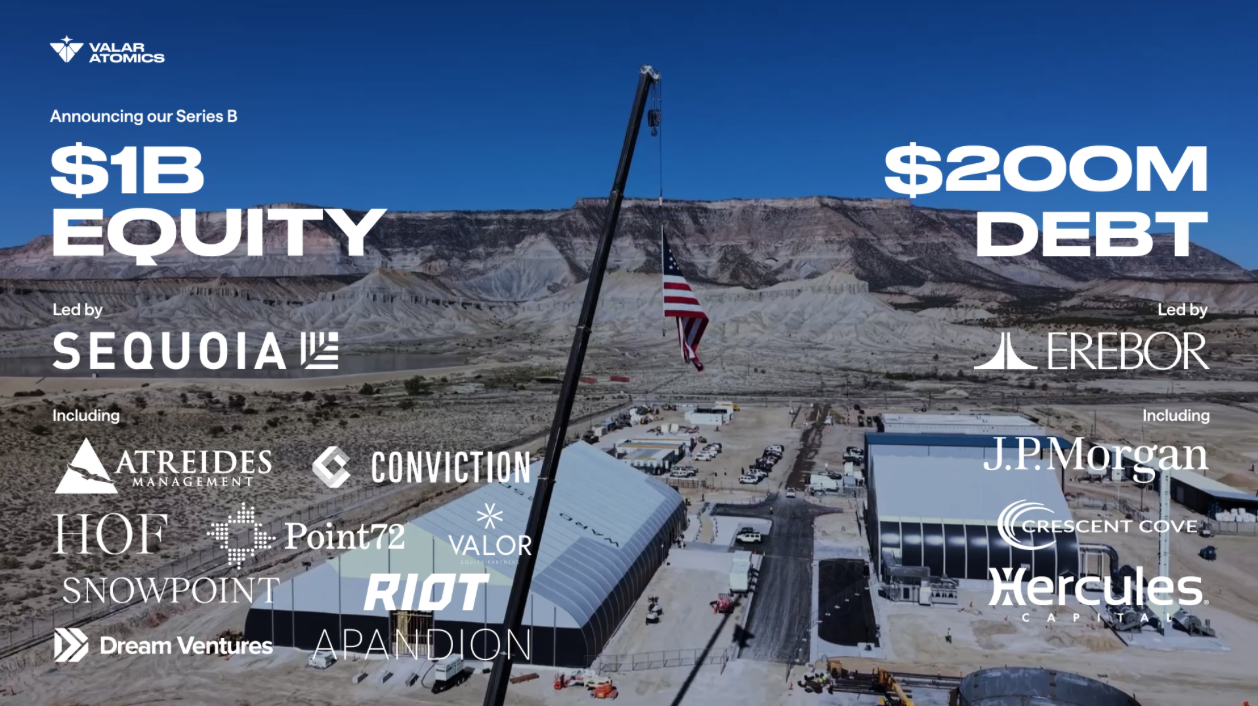
According to several media reports, the August 2026 financings value three-year-old Valar at ~$6 billion.
If true, this comes after Valar
🔴 Raised a $130 million Series A in November 2025,
🔴 Followed in March 2026 by a reported $450 million combo financing consisting of
🔺 $340 million of equity and
🔺 $110 million of debt at a valuation of ~$2 billion .
The company says that combined $1.47 billion in equity funding and $320 million in debt will help move Valar from demonstrating an integrated reactor system to
🟠 Producing fleets of standardized SMR nuclear plants, plants that
🔸 Encompass reactor deployment,
🔸 Long-term operations, and
🔸 Nuclear-fuel production.
Why Emery County?
That's where I feel the Utah story becomes particularly interesting.
In May 2025, Valar and the Utah Office of Energy Development signed a Memorandum of Understanding identifying Utah's San Rafael Energy Lab as a potential location for reactor testing and TRISO nuclear-fuel fabrication.
Utah offered access to the site, infrastructure, and shared facilities, including local machine shops.
Valar began building a Ward 250 SMR nuclear reactor at the San Rafael Energy Lab in September 2025.
Then, roughly nine months later, Valar achieved criticality there in June 2026.
The next month (9 July 2026, specifically), the Utah Governor's Office of Economic Opportunity approved Valar for a post-performance refundable tax credit worth up to $106.7 million over 10 years.
State economic-development records show Valar projecting:
✅ $1.299 billion of capital investment;
✅ 275 new full-time jobs;
✅ Nearly $337.9 million in new state wages; and
✅ Approximately $213.5 million in projected new state revenue.
The incentive equals up to 50% of projected new state revenue and is performance-based, meaning Valar must generate the qualifying economic activity before receiving the associated benefit.
Why Valar Atomics?
To be clear, the Nuclear Energy Launch Pad is not a new reactor license, operating authorization, or a federal grant, but it is significant.
The National Reactor Innovation Center, operated by Idaho National Laboratory for the DOE, says selected developers receive a prioritized pathway to the department's authorization process, along with access to specialized technical expertise, facilities and regulatory support.
And Valar is 1 of 12 entities so selected.
As explained in its news release, the NRIC program is specifically designed to help bridge the difficult gap between nuclear demonstration and commercialization.
The initiative builds upon DOE's earlier reactor and nuclear-fuel pilot programs and can support work on both federal and non-federal lands.
That latter point is particularly relevant to Valar, as explained by Valar's CEO and Founder, Isaiah Taylor, in the interview below with TBPN.
Valar Atomics' CEO + Founder, Isaiah Taylor, is 3rd from the left; Shaun Maguire of Sequoia Capital is 2nd from the left; while TBPN's Jordi Hays is on the far left and John Coogan is on the far right. Video linked to YouTube.
Unlike many advanced-nuclear companies still working toward a first reactor demonstration, Valar already has operating hardware in Utah.
And as Taylor explains in the TBPN interview, unlike other companies in the nuclear energy space, Valar prides itself on making its reactors "as simple as they can be."
"If we could just staple this thing together, like from IKEA, then this would be a trillion-dollar company much faster," he said. "We try to buy things that are completely off-the-shelf, like a hundred percent commodity. Or we make it ourselves, and there's very few things in between."
The reason for taking a simplistic approach, Taylor says, is that Valar is "... trying to go a hundred times faster than the industry has ever gone before."
So ... will it work?
I'm not a physicist, let alone a nuclear physicist.
But I heard Taylor speak earlier this month at the One Utah Summit in Cedar City, and his explanations about Valar's approach, its secret sauce, sure made sense to me.
But I'm not the person who matters here.
Instead, it's the brainiacs at the DOE, the NRIC and INL, and the Utah Office of Energy Development; they're the ones that matter.
Well, them and the investors who have now voted with their individual and collective pocketbooks to the tune of nearly $1.9 billion.
Additionally, one week after Valar's SMR in Orangeville, Utah achieved criticality, Valar reported that its Ward 250 generated electricity to power an NVIDIA Blackwell AI system.
Where, exactly, has not been disclosed publicly, although the Los Angeles Times reports that the Valar/NVIDIA facility is planned for Utah.
If accurate, that would be truly significant.
Regardless, such milestones are critical because Valar's next challenge is no longer simply proving that its reactor works.
Instead, it's figuring out how to build a lot more of them ... perhaps in Utah.
In other words, less than 18 months after Valar's initial forays into Emery County, it is now home to an unusual combination:
▪️ An operating advanced reactor,
▪️ A state-owned nuclear research site,
▪️ Available land and infrastructure,
▪️ Strong state and local government support,
▪️ A developer in Valar with access to enormous amounts of private capital (nearly $1.8 billion at last count), and
▪️ A new federal pathway toward commercialization.
Should be an interesting road ahead for Emery County, the State of Utah, and Valar Atomics.
Publisher's Note
This writeup was originally published and distributed to our Subscribers at approximately 7:35am MT on Thursday, 27 August 2026.
However, if this report/article came to your attention sometime after this date/time and you'd like to change that, then (to become a subscriber), please
1. Click on a "Subscribe" button on any Utah Money Watch webpage (visit www.UtahMoneyWatch.com),
2. Enter in your name in the proper field in the popup window that appears on-screen, and
3. Enter your preferred email address in the proper field too.
That's it. Thanks.
Team Utah Money Watch
Comments ()