
Utah Ends 98-Year Federal Land Dispute With a $60 Million Settlement, But it Retains Mineral Rights in the Process
EXECUTIVE SUMMARY
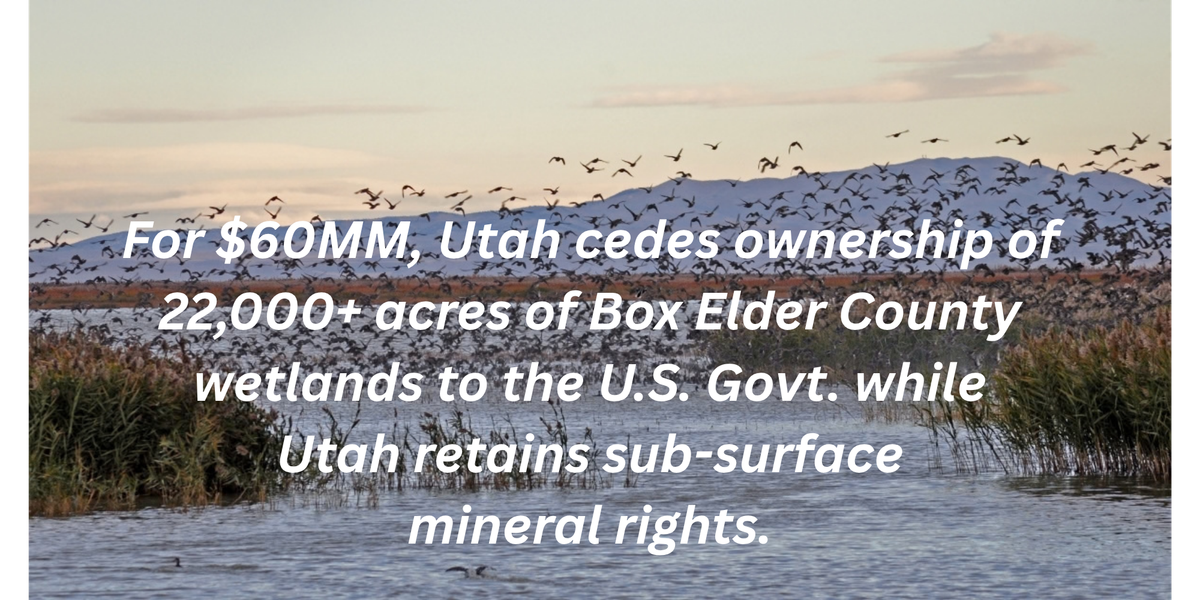
✅ Utah and the federal government have finally ended a 98-year ownership dispute involving 22,311 surface acres adjoining the Bear River Migratory Bird Refuge in Box Elder County, with the United States agreeing to pay Utah $60 million for said surface acres.
✅ Utah will transfer the surface acreage to the federal government but retain all associated mineral interests, including subsurface minerals and minerals suspended within Great Salt Lake waters or brines.
✅ Congress considered settling the same dispute for $15 million in 2002 under a proposal that also contemplated Utah relinquishing its mineral interests. Now, 24 years later, Utah will receive four times that amount while retaining those interests.
✅ The $60 million will be paid in four installments over 26 months, with the first payment expected within weeks. However, individual installment amounts and exact payment dates have not been publicly disclosed, although all proceeds must benefit the Great Salt Lake.
SALT LAKE CITY and BOX ELDER COUNTY, Utah — 30 September 2026 — A 98-year land-ownership dispute between Utah and the federal government has finally been settled, with Utah transferring ownership of 22,311 surface acres in Box Elder County to the United States government for $60 million but retaining the underlying mineral interests.
Under the settlement announced last week by the Great Salt Lake Commissioner's Office, the federal government will pay Utah in four installments over the next 26 months. The first payment is expected within weeks, although individual installment amounts and exact payment dates have not been publicly disclosed.
All $60 million must, however, be used exclusively for projects benefiting the Great Salt Lake.
The acreage will become part of the Bear River Migratory Bird Refuge, managed by the U.S. Fish and Wildlife Service.
But Utah is not relinquishing its entire economic interest in the property.
Under H.J.R. 30, approved by the Utah Legislature in March 2026, Utah expressly retains all mineral interests tied to the 22,311 surface acres, including subsurface minerals and minerals suspended within the waters or brines of the Great Salt Lake.
In effect, the federal government receives the disputed surface acreage, while Utah receives $60 million and retains the mineral estate.
A Dispute Dating Back to 1928
Congress created the Bear River Migratory Bird Refuge in 1928, but an unusual surveying problem left ownership of portions of the lakebed within the refuge unresolved.
Utah owns sovereign lands underlying the Great Salt Lake, with boundaries historically tied to an official surveyed meander line. However, for some unknown reason, that surveyed line did not extend through the refuge.
Congress itself put a number on the resulting dispute in 2002.
When lawmakers considered an earlier settlement, then-U.S. Rep. James Hansen (R-UT) told the House that Utah and the federal government had disputed ownership of the refuge lands for “nearly 75 years,” dating the conflict to creation of the refuge in 1928.
Utah and the U.S. Fish and Wildlife Service had reached a preliminary settlement on 28 September 2001, and the House passed the Bear River Migratory Bird Refuge Settlement Act the following year.
The proposed consideration at the time (the payment the state would receive) was $15 million.
Rep. Hansen described that payment as reimbursement for the disputed lands and associated oil, gas and mineral rights. The legislation called for Utah to deliver a quitclaim deed covering all lands and interests it claimed within the refuge.
But that proposal did not produce the final settlement.
Now, 24 years later, Utah will receive four times as much money while retaining its mineral interests.
$60 Million vs. $15 Million
During the closing hours of Utah’s 2026 General Session in March, lawmakers approved H.J.R. 30, authorizing the Utah Division of Forestry, Fire and State Lands to complete the negotiated transfer.
The resolution approved transfer of 22,311 acres for consideration to be used exclusively for the benefit of the Great Salt Lake and expressly preserved Utah’s mineral interests.
What changed last week is that the transaction has now been finalized, ending the ownership dispute nearly a century after it began.
What remains unclear is precisely where those dollars ultimately will go.
The settlement restricts the proceeds to projects benefiting the Great Salt Lake, but state officials have not yet publicly identified the individual
🟢 Projects,
🟢 Recipients, or
🟢 Allocations
that ultimately will receive the money.
That makes the completed land transaction the beginning of yet another money trail, one where the pathway(s) or destination(s) are not yet disclosed.
What we do know, however, is that over the next 26 months, $60 million will move from the federal government to Utah; from there, the proceeds will move into specific Great Salt Lake investments through state funding decisions.
For Utah Money Watch and interested parties, the next questions are simple:
Where does the $60 million ultimately go? How will it benefit the Great Salt Lake? And when?
Publisher's Note
Utah Money Watch reports and analyzes companies, transactions, securities, valuations and financial outcomes for informational and journalistic purposes. Nothing published by Utah Money Watch is intended as individualized investment advice or as a recommendation to buy, sell, or hold any security.
As such, this writeup was originally published and distributed to our Subscribers at approximately 08:55am MT on Thursday, 1 October 2026.
However, if this report/article came to your attention sometime after this date/time and you'd like to change that, then (to become a Free Subscriber), please
1. Click on a "Subscribe" button on any Utah Money Watch webpage (visit www.UtahMoneyWatch.com),
2. Enter your name in the proper field in the popup window that appears on-screen, and
3. Enter your preferred email address in the proper field too.
That's it. You've now joined the ranks of our Free Subscribers.
So, thanks.
Team Utah Money Watch

Comments ()