
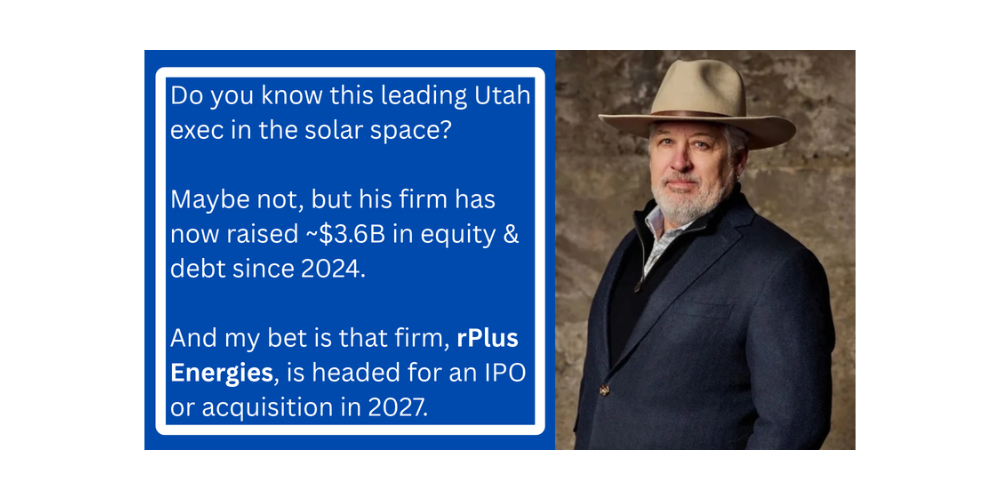
With its New $450 Million Credit Facility, Utah-based rPlus Energies has now Raised ~$3.6 Billion Since 2024
EXECUTIVE SUMMARY
✅ rPlus Energies, headquartered in Salt Lake City, Utah, has closed a new three-year revolving credit facility of up to $450 million, supported by cash flows from nearly 1 gigawatt of operating renewable-energy assets.
✅ The rPlus Green River Energy Center, which entered commercial operation in June, is helping support the new credit facility, further highlighting the company's shift from developing projects for sale toward owning and operating energy infrastructure.
✅ Since February 2024, rPlus has announced approximately $3.6 billion in financing commitments and credit facilities, including up to $460 million in corporate equity, more than $600 million in project tax equity, and roughly $2.5 billion in debt and credit arrangements.
✅ Given the combination of its financing and operational success, I would not be surprised to see rPlus complete some type of financial exit in 2027, whether through an Initial Public Offering or via a Merger or Acquisition.
SALT LAKE CITY — 10 November 2026 — Salt Lake City, Utah-headquartered rPlus Energies has closed a new three-year revolving credit facility of up to $450 million, bringing its publicly announced financing commitments and credit facilities since February 2024 to ~$3.6 billion.
That history includes
🔶 Up to $460 million in corporate equity commitments,
🔶 Over $600 million in project tax equity, and
🔶 Roughly $2.5 billion in debt and credit arrangements.
{AUTHOR'S NOTE: To be clear, the amounts that rPlus Energies has disclosed are not a measure of cash received, debt outstanding, or company valuation.}
From my perspective, the breakdown of such historical financing commitments for rPlus does reveal something more interesting than the latest borrowing capacity alone:
rPlus is turning power plants that once required substantial construction financing into operating assets whose cash flows can help finance its next projects.
Among them is the Green River Energy Center in Emery County, Utah. rPlus broke ground on its Green River project in mid-September 2024 and began commercial operation there in June 2026.
Video courtesy of KOAL-AM/FM of Price, Utah.
The Money Behind the rPlus Expansion
A reconstruction of the company's major disclosed financings since February 2024 shows three distinct sources of capital, specifically —
⚫️ Corporate equity: In February 2024, Sandbrook Capital committed up to $460 million to rPlus, alongside continued backing from founding investor Gardner Group.
⚫️ Project tax equity: The company reported more than $600 million in 2025 commitments, comprising
▪️ Over $500 million for Green River through RBC Community Investments and other investors, including Utah-based FJ Management, and
▪️ ~$100 million for its Pleasant Valley Solar 2 project in Idaho through Truist Bank.
⚫️ Debt and credit: Approximately $2.5 billion in announced facilities, including
▪️ About $1.1 billion for Green River,
▪️ $179 million for Pleasant Valley Solar 2,
▪️ $125 million in corporate letter-of-credit capacity arranged with Deutsche Bank,
▪️ Over $650 million for the Blacks Creek Energy Center in Idaho, and
▪️ The new $450 million facility.
It's important to understand that those amounts should be separated into different funding categories, as
🟥 Corporate equity finances the business itself;
🟥 Project tax equity helps fund qualifying projects in exchange for tax benefits and investment returns; while
🟥 The debt-and-credit category includes
🔺 Construction loans,
🔺 Bridge loans,
🔺 Guarantees and borrowing capacity,
not simply money advanced to rPlus.
Moreover, what has not been disclosed by rPlus is whether some short-term loans have been paid down or refinanced using later financing.
Additionally, the company has not disclosed the amount of tax equity committed to Blacks Creek.
As such, the ~$3.6 billion is a tally of announced financing arrangements, not $3.6 billion of separate, currently outstanding capital.
Why Green River Changes the Story
Completed in Utah's Emery County, the Green River Energy Center combines 400 megawatts (MW) of solar generation, with a 400 MW battery system providing up to four hours of storage, or 1,600 megawatt-hours.
Electricity from the rPlus Green River project is contracted to PacifiCorp under a long-term agreement.
According to a disclosure by KeyBanc Capital Markets, rPlus closed approximately $1.1 billion in senior secured credit facilities in July 2024 for its Green River project, specifically:
🟣 $699 million in construction loans,
🟣 $270 million in tax-credit bridge loans, and
🟣 $123 million in letters of credit.
Separately, over $500 million in project tax equity followed in June 2025.
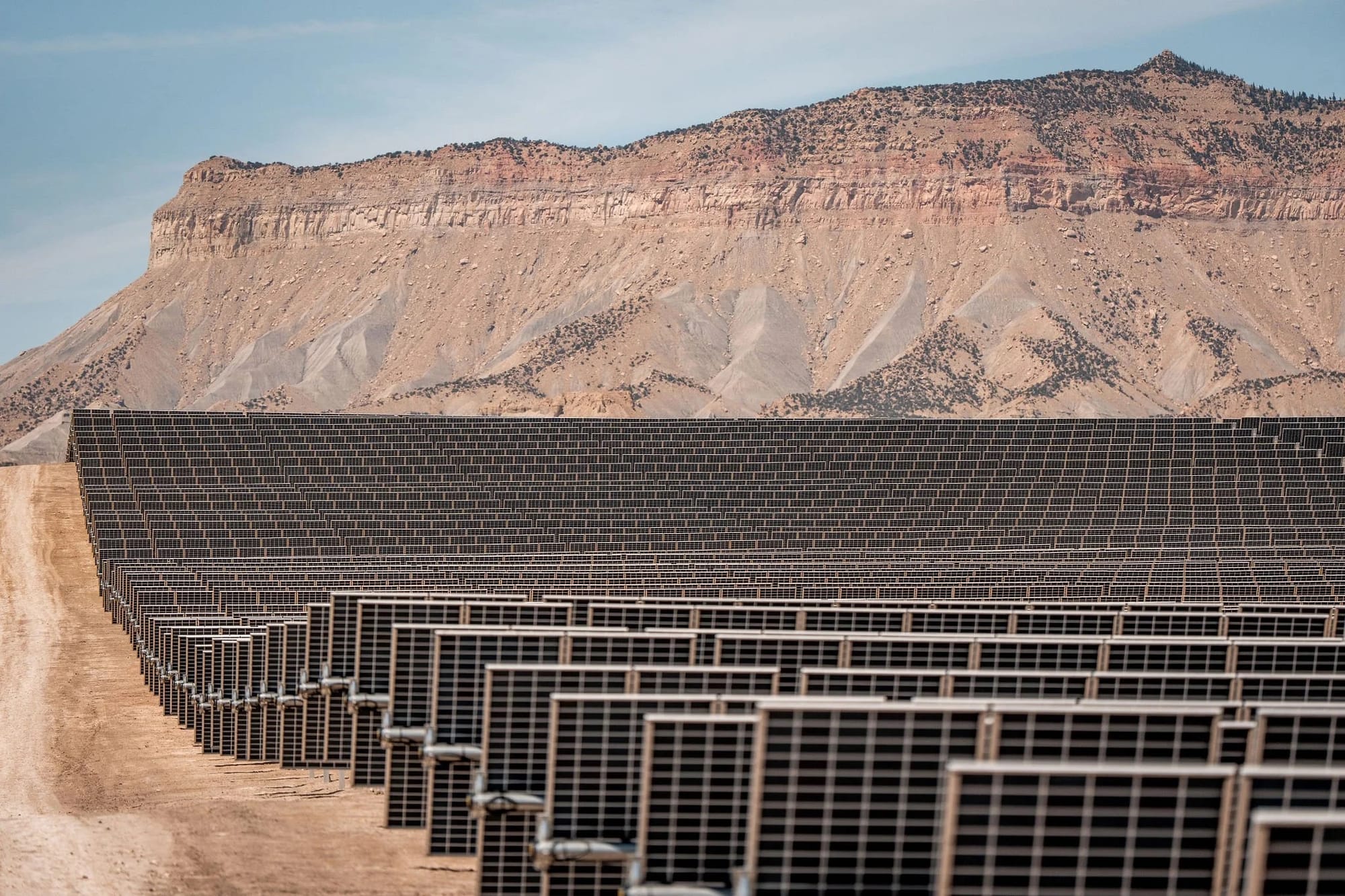
KeyBanc's disclosure also noted that Green River would be the first project rPlus would retain as an owner, a reality KeyBanc wrote was "... made possible with the support of Sandbrook Capital."
Such a distinction is important because in 2023 rPlus sold a controlling interest in its earlier Idaho Pleasant Valley Solar project to Matrix Renewables.
On 23 June 2026, rPlus announced Green River's commercial operation, and the company projects more than $55 million in property taxes for schools and public services over 20 years. {AUTHOR'S NOTE: Those are projected benefits, not taxes already collected.}
Less than five months later, the company's operating cash flows were identified as supporting the new corporate credit facility, while Green River has become more than an electricity-generating asset. In fact,
Green River also forms part of the financial base for rPlus's expansion plans.
What Seven Banks Are Financing
The new $450 million credit facility combines revolving borrowing capacity, which can be repaid and reused, with letters of credit that back contractual obligations.
Canadian Imperial Bank of Commerce (CIBC) organized the financing and will administer it, while the other participants are
🔶 National Bank of Canada,
🔶 Truist Bank,
🔶 KeyBank,
🔶 Wells Fargo,
🔶 MUFG, and
🔶 Salt Lake City-based Zions Capital Markets, a division of Zions Bancorporation, N.A. (NASDAQ: ZION).
The facility is supported by cash flows from nearly 1 gigawatt of operating solar and storage assets, including Green River and the 125 MW Pleasant Valley Solar 2 project in Ada County, Idaho, which also reached commercial operation in 2026.
{AUTHOR'S NOTE: On 17 March 2026, rPlus announced it had secured more than $650 million in debt facilities for its 400 MW Blacks Creek Energy Center, now under construction in that same county.}
To me, the participation of seven separate lenders suggests confidence in the cash-generating assets supporting rPlus's growth strategy. It does not, however, establish that the company is profitable, or that every operating power plant has been directly pledged as collateral.
And one should consider whether or not there is a trade-off.
Specifically, a reusable corporate facility can help fund development before each new project secures its own long-term financing. But cash flows from completed facilities may also be exposed to obligations associated with projects still being developed.
As such, the three-year term means rPlus will eventually need to repay, renew, or refinance the facility.
So far, however, rPlus has not disclosed
🟢 The amount drawn at closing,
🟢 Interest rates,
🟢 Detailed collateral arrangements,
🟢 Current debt outstanding, or
🟢 Which developments will receive financing.
Then again, as a privately held company, rPlus is not obligated to make such disclosures.
The larger story is therefore not simply another $450 million secured by a Utah company. Rather, I believe it's the emergence of a different financing model:
rPlus Energies is increasingly using the earning power of projects it owns to help pay for projects it has yet to build.
How successfully it manages that balance will help determine what its next phase of growth looks like.
What's Next for rPlus Energies?
The basic yet honest answer is quite straightforward:
Execute. Execute. Execute.
Will rPlus need more capital, whether in debt or equity? It's hard to say.
However, if rPlus announces sometime in the first half of 2027 that it has raised additional monies through the sale of equity in the firm, I would see that as a possible sign that the company and its primary shareholders are preparing for some type of an "exit," potentially in the latter half of the year.
Do I have inside knowledge about this? No.
But I do have 40+ years of working with dozens of firms in pre-IPO and pre-M&A environments, so something to watch for.
In the meantime, bravo to Team rPlus for its continuing successes.
Publisher's Note
Utah Money Watch reports and analyzes companies, transactions, securities, valuations and financial outcomes for informational and journalistic purposes. Nothing published by Utah Money Watch is intended as individualized investment advice or as a recommendation to buy, sell, or hold any security.
As such, this writeup was originally published and distributed to our Subscribers at approximately 6:40am MT on Tuesday, 10 November 2026.
However, if this report/article came to your attention sometime after this date/time and you'd like to change that, then (to become a Free Subscriber), please
1. Click on a "Subscribe" button on any Utah Money Watch webpage (visit www.UtahMoneyWatch.com),
2. Enter your name in the proper field in the popup window that appears on-screen, and
3. Enter your preferred email address in the proper field too.
That's it. You've now joined the ranks of our Free Subscribers.
So, thanks.
The Utah Money Watch Team


Comments ()