
With the 2026 Legislative Session Opening Today, What is the State of Utah's Economy?
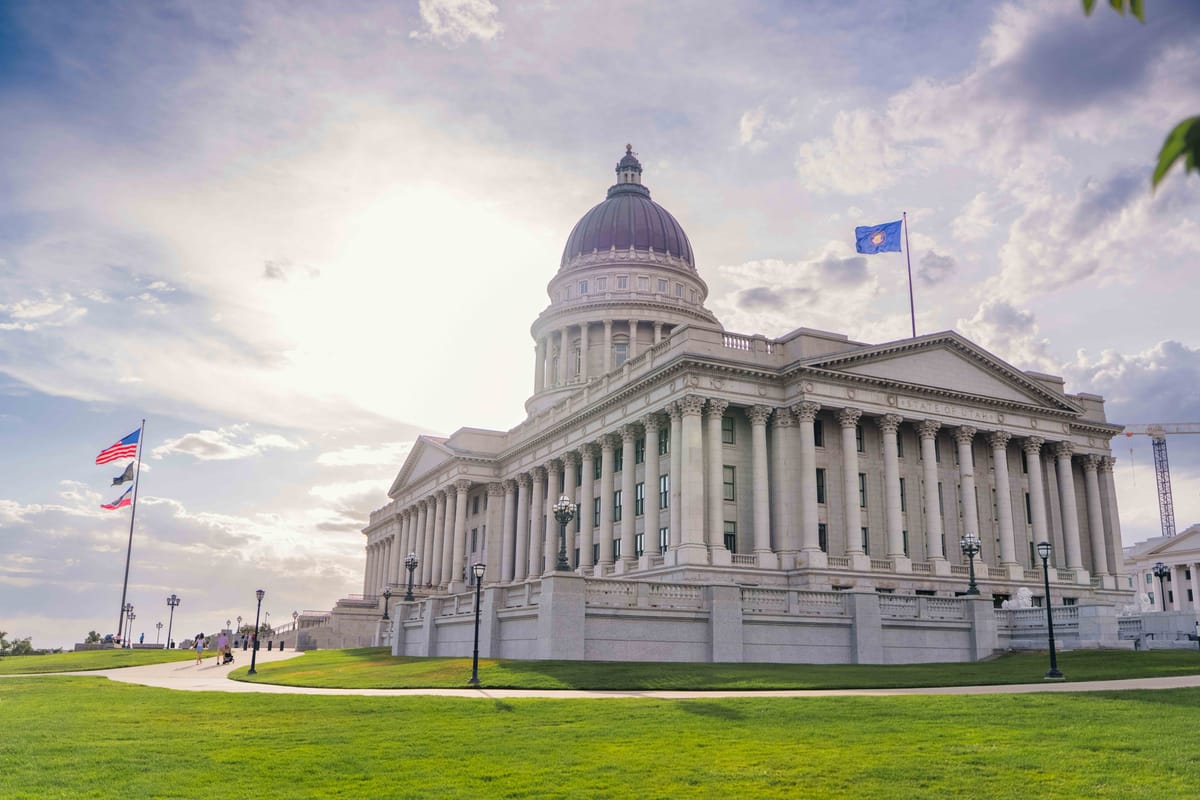
With a $30.8 recommended Fiscal 2027 budget from Utah Governor Spencer Cox staring them in the face, Utah's part-time legislators open the 2026 Legislative Session today with projections that they will introduce nearly 1,200 bills over the next six weeks, a close to 33% increase over last year's total.
With this reality in mind, the Utah Chamber (in partnership with the University of Utah's Kem C. Gardner POLICY INSTITUTE), presented their 2026 Economic Report to the Governor on Friday at the 2026 Utah Economic Outlook & Public Policy Summit.
The data and information they shared centered around 12 focus areas for consideration by Governor Cox (the state's "CEO") and its legislators:
- Education / Workforce Development,
- Energy / Critical Minerals,
- Environment / Public Health,
- The Great Salt Lake,
- Health Care,
- Homelessness / Public safety,
- Housing Affordability,
- Natural Resources / Growth,
- The Tax / Regulatory Environment,
- Technology / Innovation,
- Transportation / Infrastructure, and
- Preparation for the 2034 Olympic and Paralympic Winter Games.
Why?
Well, for starters, besides Utah's projected $30.8 billion budget for FY 2026, the 2026 Economic Report for the Governor estimates that the state Gross Domestic Product for 2026 will hit $333.8 billion, a bump of 5% versus the 2025 Utah GDP as projected last year by the Chamber and the Gardner Policy Institute.
Yup, and that nearly $335 billion GDP? That works out to over $95,000 on a per capita basis across each of the state's 3.5 million citizens.
So ... with these facts in mind, what questions and observations do I have going into this year's Legislative Session, especially with the data and information contained in the 56-page 2026 Economic Report for the Governor from Chamber and the Institute?
After a deep dive into the Report, I've boiled its data/information down to my seven items of primary emphasis, which I've summarized and highlighted below.
My Seven Highlights Going into Utah's 2026 Legislative Session
ONE: Utah's "Fertility Rate" is Dropping, But We're Still the Youngest State in the United States
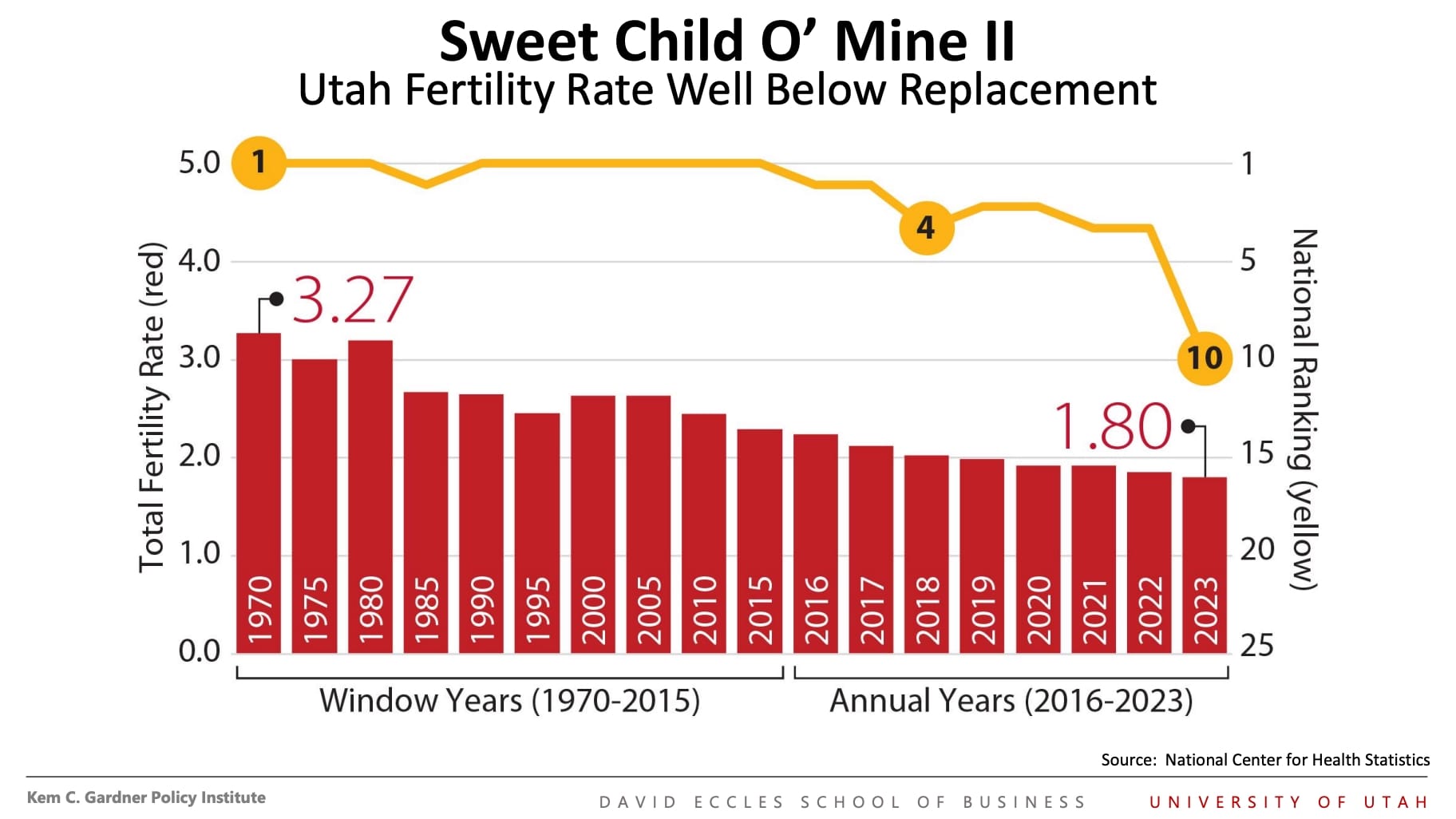
As noted above, Utah's birth rate has dropped to 1.8 births per family versus 3.27 births per family in 1970, a Total Fertility Rate that now ranks Utah at No. 10 in the U.S.
That's a drop of nearly 1.5 births per family in roughly 70 years, a trend described as troubling by Phil Dean, the Institute's Chief Economist and Public Finance Senior Research Fellow.
Unless this changes or in-state migration jumps significantly, Utah's population growth will continue to slow and eventually shrink over time.
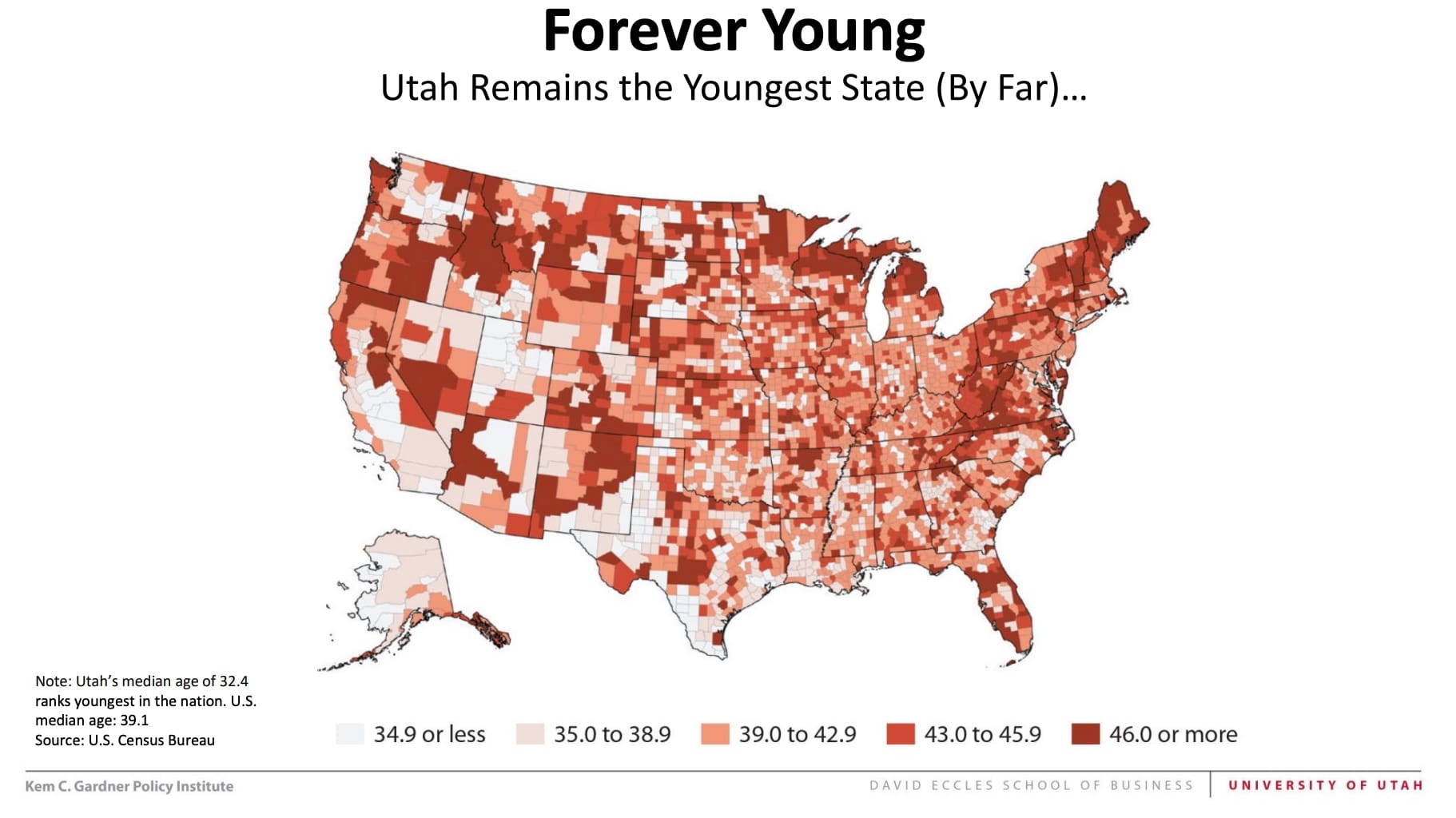
Notwithstanding this fact, Utah's median age of 32.4 years still ranks it as the lowest in the country, substantially lower than the median age of the entire country of 39.1 years (as shown in the graphic below).
TWO: Utah has Hit an "All-Time High" in Oil Production
According to data published in the 2026 Economic Report for the Governor (and presented during last Friday's Summit), the state of Utah has achieved an all-time high in oil production of nearly 70 million barrels of oil produced annually (as shown in the graphic below).
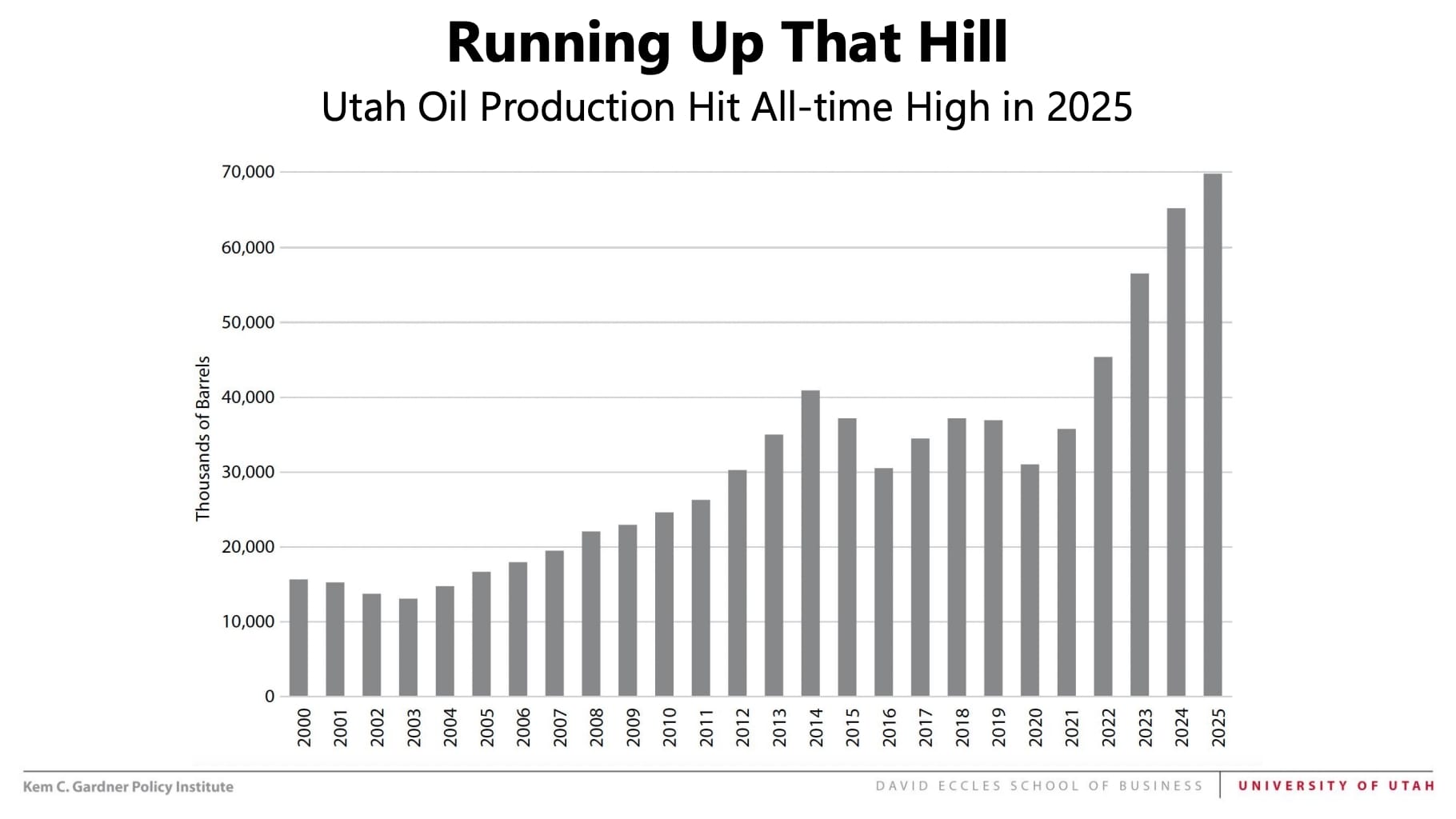
The upshot of this transition is that Utah is again a net exporter of oil.
THREE: 2025 Estimated Job Growth in Utah was Up in 9 of 11 Industries, Highlighted by the Education/Health Services and Construction Sectors
As noted on Page 36 of the Report (see the graphic below), estimated job growth in 2025 was up in 9 out of 11 industry segments, led by
- 3.8% growth in Education and Health Services, and
- 3.3% growth in Construction.
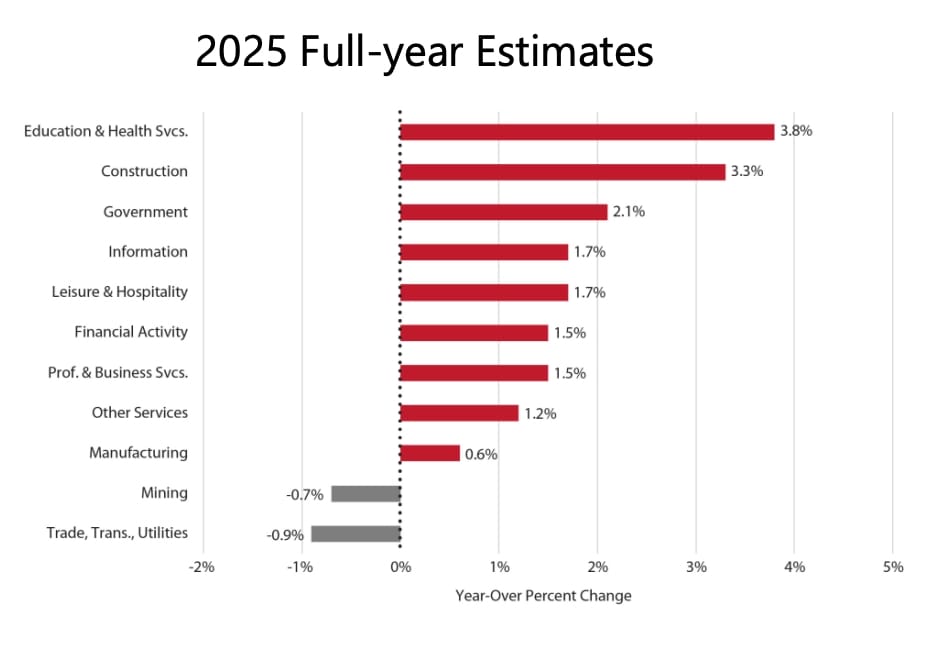
Interestingly, given the state hitting an all-time high in oil production, the Mining industry (which includes all forms of mineral extraction, including oil extraction), showed an estimated 2025 job decrease of 0.7% for the near.
Why? I have no idea.
FOUR: Utah's Economic Diversity Ties it for 7th in the U.S.
As noted in the graphic below, Utah is tied as the 7th-most economically diverse economy among states in the U.S., a distinction it holds with Maryland with scores of 95.3 out of 100.
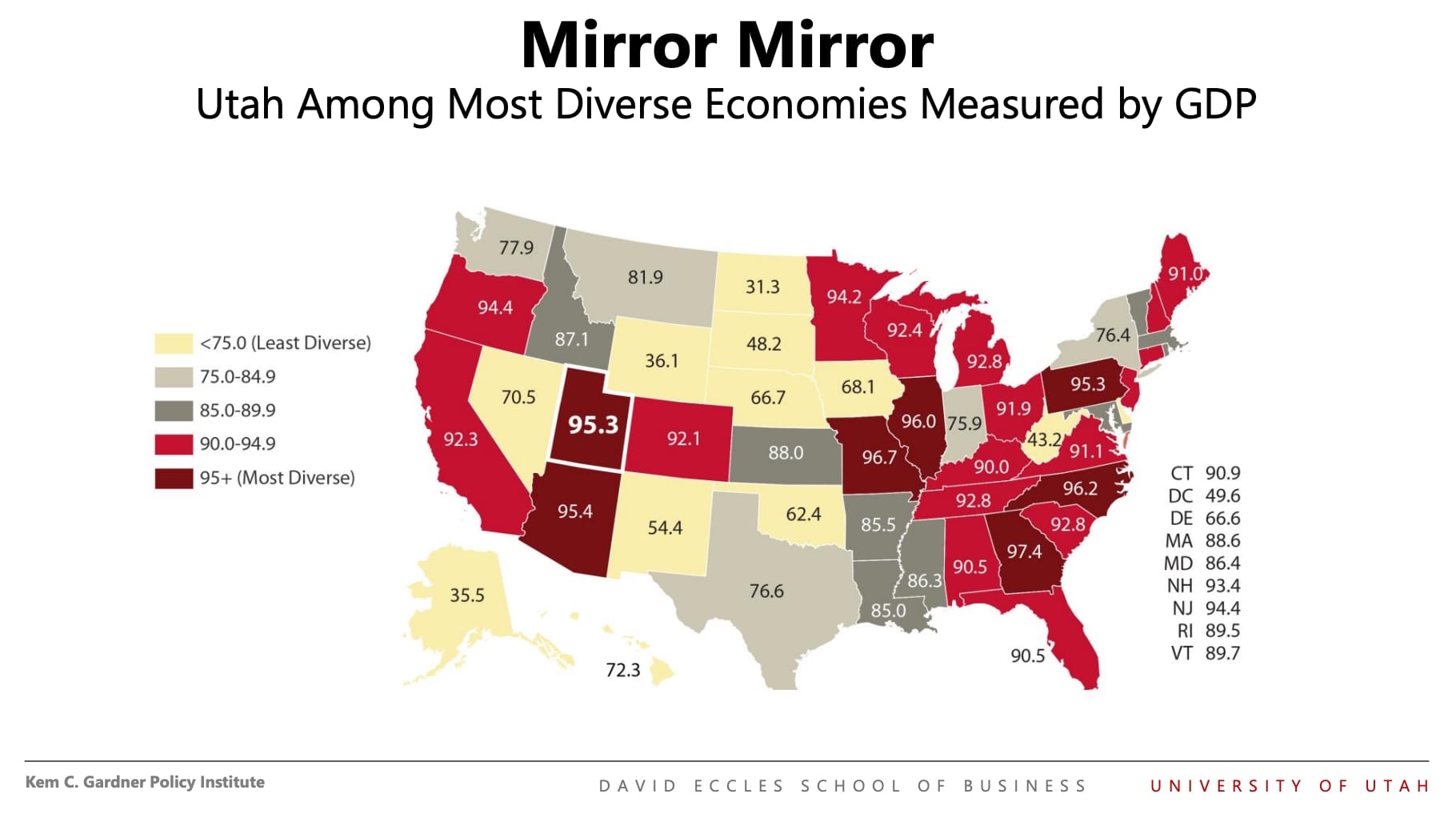
Such economic diversity means greater resiliency for the state's economic during times of financial stress.
FIVE: Utah's Most Economically Diverse Counties are Salt Lake, Davis, Weber, Utah, and Washington
As highlighted in the graphic below, the five most economically diverse counties in Utah are (in descending order):
- Salt Lake County, at 94.0 out of 100;
- Davis County at 85.0;
- Weber County at 84.9;
- Utah County at 84.8; and
- Washington County at 84.1.
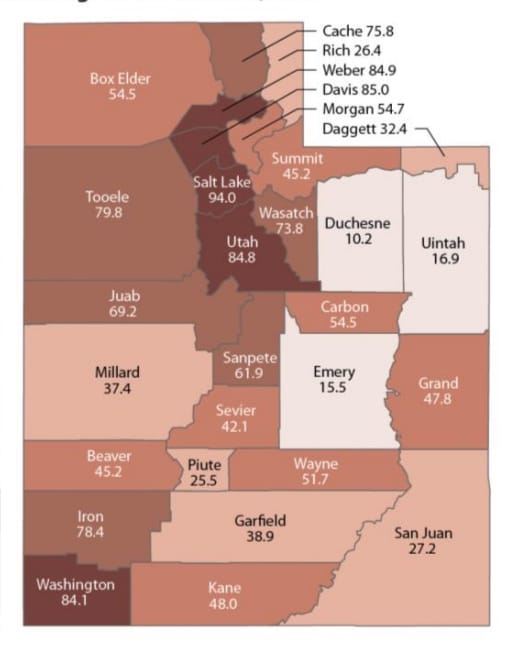
Conversely, three Utah counties come in with economic diversity scores of under 20, specifically
- Duchesne County at 10.2;
- Emery County at 15.5; and
- Uintah County at 16.9.
SIX: Projected Personal Income Growth of 4.9% in 2026
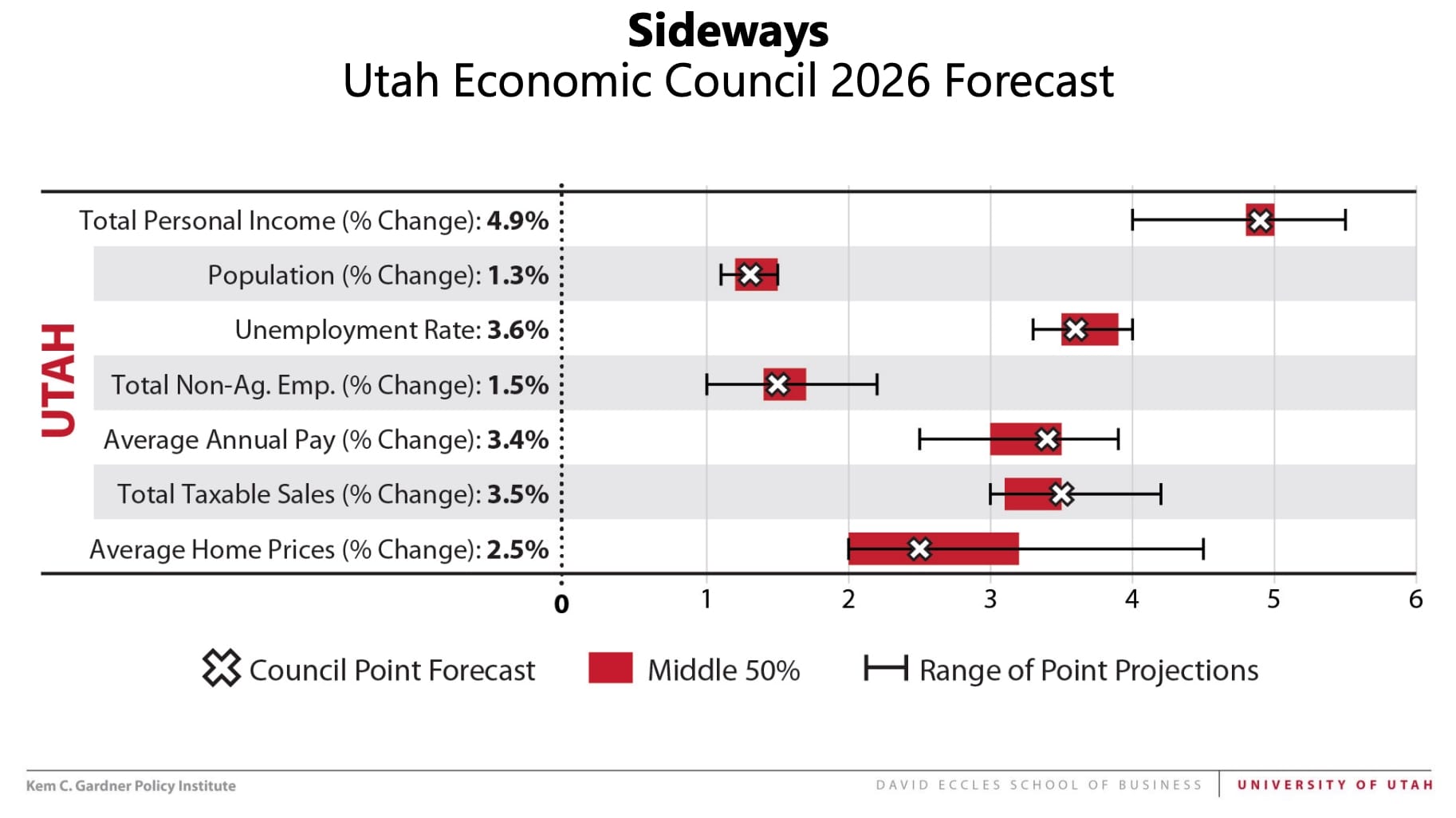
As noted in the graphic above, the Chamber and Institute are projecting a 4.9% increase for personal income in 2026, not a massive increase, but not insignificant either.
SEVEN: Utah's "Magnificent Seven" and "Troubling Seven" as Defined by the Chamber and the Institute
As highlighted in the graphic below, the Institute and Chamber combined to identify the seven most encouraging (and challenging) realities they see in the state of Utah today.
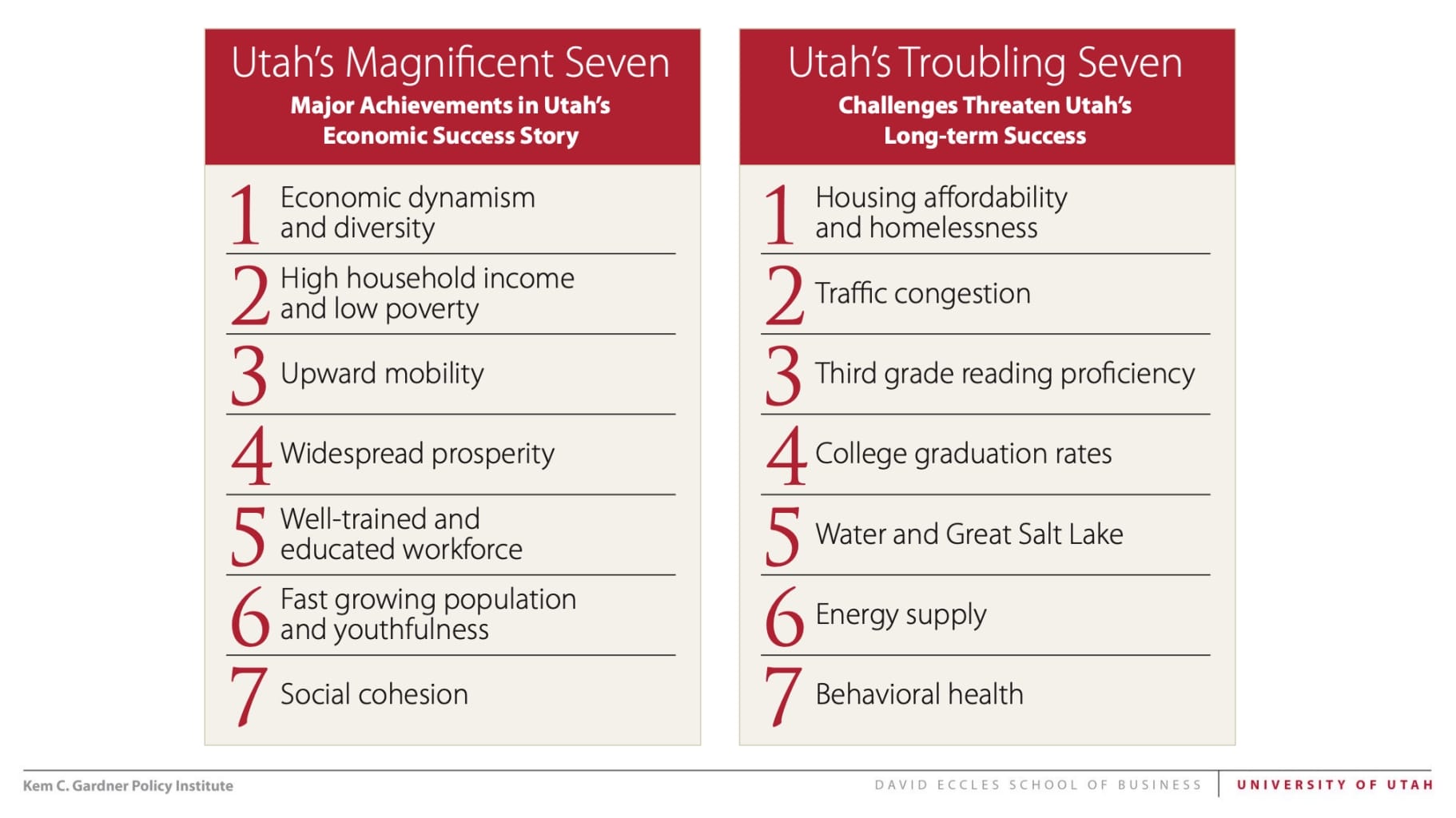
Of the Magnificent Seven, I personally rank
- No. 5 (Well-trained and educated workforce) and
- No. 1 (Economic dynamism and diversity)
as most encouraging.
Conversely, of the Troubling Seven, I lose the most sleep about
- No. 1 (Housing affordability, and homelessness);
- No. 6 (Energy supply);
- No. 5 (Water and Great Salt Lake); and
- No. 2 (Traffic congestion).
How will the Legislature Address the Areas of Concern Raised by the Chamber and Institute?
Utah's political party super majority notwithstanding, the reality is that the state continues to grow and its diversity is increasing, as are the needs of its citizens, businesses, and nonprofit entities.
How such needs will be addressed by the Legislature and Governor, if at all, is hard to predict, regardless of a proposed $30.8 billion budget for the state, let alone a projected $333.8 billion statewide GDP.
Longer term, I believe that elected officials can continue to make present-day decisions to address statewide concerns/challenges in the areas of
- Energy,
- Water, and
- Traffic Congestion.
However, housing affordability?
That's a bit trickier-nut to crack.
In fact, unless the state wants to get into the residential mortgage business, I do not see how the state can positively impact this challenge.
But ... I could be wrong.
From my perspective, that's what makes tracking the progress of legislation coming out of each year's six-week session so fascinating to watch.
Should you want to get involved, I invite you to contact your state Representative and/or Senator as highlighted on the official Utah Legislature website.
Publisher's Note
This writeup was originally published and distributed to our Subscribers at approximately 07:55am MT on Tuesday, 20 January 2026.
However, if this report/article came to your attention sometime after this date/time and you'd like to change that, then (to become a subscriber), please
1. Click on a "Subscribe" button on any Utah Money Watch webpage (visit www.UtahMoneyWatch.com),
2. Enter in your name in the proper field in the popup window that appears on-screen, and
3. Enter your preferred email address in the proper field too.
That's it. Thanks.
Team Utah Money Watch



Comments ()