
The Co-Founders of Utah's Largest Long-Term Care Firm have Now Led the Largest-Ever BYU Athletics Financial Commitment After Selling Over $725 Million of Stock
EXECUTIVE SUMMARY
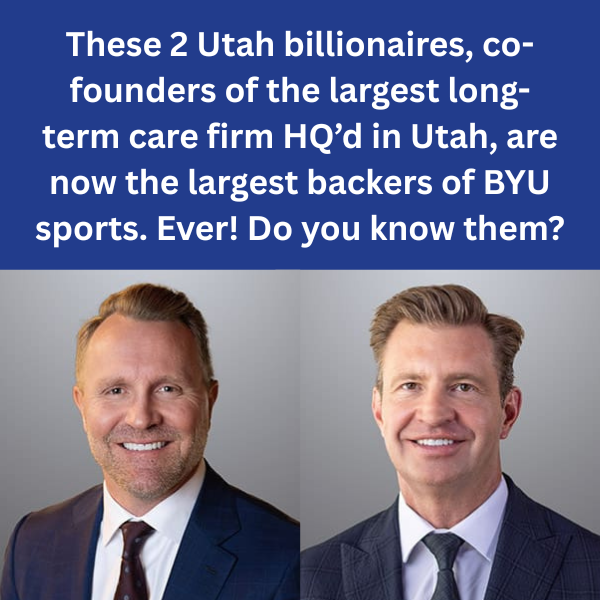
✅ Two Utah businessmen (who have sold more than $725 million of personally owned stock in the largest long-term care firm headquartered in Utah), are also the principals behind the largest philanthropic commitment in BYU Athletics history.
✅ The businessmen are PACS Group Co-Founders, Jason Murray and Mark Hancock, whose investment firm, PV3 Enterprises, has entered into a long-term partnership with BYU Athletics involving football facilities, over 40 student-athlete NIL agreements, business mentoring, and the newly named PV3 Field at LaVell Edwards Stadium.
✅ Based upon SEC filings, Hancock and Murray received roughly $656.8 million in gross proceeds from personally owned PACS stock sold through the company’s 2024 IPO and secondary offering, with additional sales during 2026 pushing their combined gross proceeds above $725 million.
✅ Despite those sales, the two founders still own nearly 108 million shares of PACS Group, as BYU says PACS itself remains one of the athletic department’s largest partners following the new PV3 agreement.
PROVO, Utah and SALT LAKE CITY — 13 October 2026 — Two Utah businessmen who have sold more than $725 million of stock in one of the state's most successful healthcare companies are putting another of their business ventures onto one of the most visible stages in Utah.
And this time, that stage is literally a football field.
The announcement says that PV3's
"Historic gift and long-term strategic partnership will strengthen football infrastructure and create an innovative NIL program for student-athletes."
The partnership between the two organizations is described as a broader, long-term relationship that also includes
🔷 Football-facility investment,
🔷 Endorsement agreements involving more than 40 student-athletes,
🔷 Business mentoring, and
🔷 Prominent branding.
To be clear, the size of that financial commitment was not disclosed.
But the identities of the two men behind PV3 Enterprises make the announcement significantly more interesting.
They are Jason Murray and Mark Hancock, the two Co-Founders of Salt Lake City-based PACS Group (NYSE: PACS), the largest long-term care company headquartered in Utah, and businessmen whose holdings in PACS have made each of them worth billions of dollars on paper.
And since PACS went public just over two-and-a-half years ago, the two founders have also converted a substantial portion of that paper wealth into cash.
More Than $725 Million of PACS Stock Sold
Hancock and Murray founded PACS Group in 2013, beginning with two post-acute-care facilities.
By 11 April 2024, when the company launched its initial public offering, PACS had grown sufficiently large to enter the public markets at $21 per share.
{See "Farmington-based PACS is Poised to Shock Utah's Biz Community with its $3.1 Billion IPO Slated to Hit Today, Thursday, 11 April 2024" for more details.}
The company itself sold 21.43 million newly issued shares in that IPO.

But Hancock and Murray also granted the underwriters an option to purchase 3,214,284 of the founders' personally owned shares, and that option was exercised in full.
At the $21 IPO price, those founder-owned shares generated approximately $67.5 million in gross proceeds, monies that went directly to the two co-founders.
Five months later, the numbers became considerably larger when, in September 2024, PACS completed a secondary public offering at $36.25 per share.
Between the shares initially offered by selling shareholders and the underwriters' fully exercised option, Hancock and Murray sold another 16.25 million shares.
The gross value? Approximately $589.3 million.
Again, those were shares held by the selling shareholders, not stock sold by PACS for the company's account.
Combined, the two 2024 transactions represented roughly $656.8 million of gross stock-sale proceeds for the co-founders.
And they were not finished.
During 2026, Hancock and Murray separately began selling additional PACS shares under Rule 10b5-1 trading plans, arrangements regulated by the U.S. Securities and Exchange Commission that permit insiders to establish predetermined stock-sale instructions.
Since the beginning of 2026, Hancock has sold approximately 1 million additional shares, generating ~$41 million in gross proceeds.
Murray, meanwhile, has sold more than 646,000 additional shares, producing ~$28 million.
According to SEC filings, through 7 October 2026,
🟢 Murray's latest filings show him with ~54.44 million shares, while
🟢 Hancock's latest filings show him with ~53.52 million shares.
Add the 2026 transactions to the founders' 2024 sales and Hancock and Murray have now generated over $725 million in combined gross proceeds from sales of personally owned PACS stock.
Yet they still own nearly 108 million shares combined between the two of them.
In other words, the pair have extracted over $725 million in combined gross proceeds while retaining equity positions worth several billion dollars each, based upon recent PACS trading levels on the New York Stock Exchange.
{AUTHOR'S NOTE: Common shares of PACS stock closed at $44.30/share yesterday (Monday, 12 October 2026). Based upon 158.27 million shares outstanding, that gives PACS Group a market capitalization (aka, valuation) of over $7.0 billion}
Nothing has been shared or filed publicly that shows that proceeds from any particular PACS stock sale funded PV3, its investments, or its new BYU relationship.
But the stock transactions demonstrate the extraordinary personal financial capacity now associated with the two businessmen behind PV3 Enterprises.
PACS Became a Multi-Billion-Dollar Company
The source of that wealth is a company Hancock and Murray built at remarkable speed.
For 2025 (ended December 31), PACS Group reported
🔶 $5.29 billion in 2025 revenue (up 29.3% from 2024), along with
🔶 $191.5 million in net income, and
🔶 $505 million in adjusted earnings before interest, taxes, depreciation and amortization (EBITDA).
At year-end 2025, PACS employed 47,455 people and operated 321 post-acute-care facilities in 17 states. It has continued expanding during 2026.
Murray remains Chief Executive Officer and Chairman, while Hancock (who served as its first chief financial officer), retired from his executive position on 30 June but remains as Vice Chairman and as a Director.
The company's rise, however, has not been without turbulence.
The Hindenburg Hangover
On 4 November 2024, short-selling research firm Hindenburg Research (now closed) published a highly critical report accusing PACS of, among other things, improperly accessing Medicare benefits, questionable billing practices, and problematic related-party arrangements.
PACS Group strongly disputed the allegations, but the fallout was severe, as
🔴 The company's shares fell sharply;
🔴 Financial filings were delayed; and
🔴 PACS ultimately restated its first- and second-quarter 2024 financial statements, including revenue reductions of
🔺 $14.9 million, and
🔺 $46.1 million, respectively (for the two quarters noted above), and
🔴 The company also identified material weaknesses in its internal controls.
In September 2025, then-Chief Financial Officer (Derick Apt) resigned after an Audit Committee investigation determined he had accepted high-value items from parties associated with certain related entities, a matter separate from the direct allegations raised by Hindenburg.
However, PACS subsequently
🟣 Resumed its required financial reporting,
🟣 Reported record 2025 revenue and earnings, and
🟣 Continued expanding.
And yet, since hitting its all-time low of $7.50/share on 9 September 2025, the value of PACS common shares is now up over 490% in just over 13 months.
In other words, Wall Street has rewarded the PACS team and its shareholders for their efforts, in spite of past challenges that have long been addressed.
For readers who want the deeper history, Utah Money Watch examined the early stages of the Hindenburg/PACS battle in December 2024. U$W's December 2024 PACS/Hindenburg report
And now Hancock and Murray are increasingly visible outside PACS.
Enter PV3 Enterprises
Last Friday's announcement identifies both men as principals of PV3 Enterprises, which BYU Athletics describes as a Utah-based investment and operating company that deploys patient capital and active ownership across a diversified group of businesses.
PV3 first surfaced publicly in April 2024, when Bicycle Retailer and Industry News reported that the Utah investment firm announced its acquisition of Ogden-based ENVE Composites from Amer Sports, a story published less than three weeks after PACS Group's initial public offering.
Since then, other firms that have become PV3 portfolio companies include
⚫️ 83rd Marketplace,
⚫️ Pica Rica BBQ,
⚫️ Red 7 Marketing,
⚫️ Round Valley Golf,
⚫️ Seven Brothers Burgers, and
⚫️ The former Utah Motorsports Campus near Grantsville, Utah now known as West Desert.
{AUTHOR'S NOTE: Yes, the Utah Motorsports Campus was originally known as the Miller Motorsports Park, after its launch in 2006 by Larry H. Miller.}
The new BYU relationship puts those businesses directly into the university's rapidly evolving name, image and likeness ecosystem (NIL).
More than 40 current BYU student-athletes are involved in the initiative, with endorsement opportunities expected across PV3's portfolio.
The agreement also gives PV3 one of the most conspicuous corporate branding positions in Utah sports as the playing surface inside LaVell Edwards Stadium is now PV3 Field.

That branding was plainly visible Friday night as undefeated BYU defeated Iowa State before a nationally televised audience.
And the exposure will not only continue, but it will grow, especially given the ABC prime time game this Saturday night when the Cougars take on the Fighting Irish of Notre Dame.
PACS Is Still a Major BYU Partner
The arrival of the PV3 name raised an obvious question.
For several years, PACS Group itself had been a major BYU Athletics sponsor, including prominent football-related branding.
Had PV3 replaced PACS? Apparently not.
In response Monday to questions from Utah Money Watch, BYU Athletics' Senior Associate Athletic Director for Corporate Sponsorships, Casey Stauffer said:
“PACS still remains a significant partner with athletics, among the biggest we have.”
That clarification is important.
The new PV3 relationship therefore does not represent a simple substitution of one Hancock-and-Murray-associated name for another.
Instead, PACS Group remains one of BYU Athletics' largest partners while PV3 Enterprises has separately emerged with the record philanthropic commitment, the football field naming rights and a broad new NIL and business-development platform.
Exactly how those relationships were divided (and how PV3 itself has developed alongside the extraordinary wealth created through PACS) is a more complicated story.
And it leads directly to Part Two.
On Thursday, Utah Money Watch will examine PV3 Enterprises itself:
🔹 Who controls it,
🔹 What it owns,
🔹 Where it has been investing,
🔹 How its portfolio has grown, and
🔹 What can (and cannot) be established about the capital behind it.
So that's coming this Thursday, less than 72 hours before the Top 10 matchup at LaVell Edwards Stadium.
On PV3 Field no less.
Publisher's Note
Utah Money Watch reports and analyzes companies, transactions, securities, valuations and financial outcomes for informational and journalistic purposes. Nothing published by Utah Money Watch is intended as individualized investment advice or as a recommendation to buy, sell, or hold any security.
As such, this writeup was originally published and distributed to our Subscribers at approximately 09:45am MT on Tuesday, 13 October 2026.
However, if this report/article came to your attention sometime after this date/time and you'd like to change that, then (to become a Free Subscriber), please
1. Click on a "Subscribe" button on any Utah Money Watch webpage (visit www.UtahMoneyWatch.com),
2. Enter your name in the proper field in the popup window that appears on-screen, and
3. Enter your preferred email address in the proper field too.
That's it. You've now joined the ranks of our Free Subscribers.
So, thanks.
The Utah Money Watch Team


Comments ()