
Show Me the Money. Then Show Me the Wins. With an Estimated $50 Million Going to FBS Players in Utah this Season, How Many Football Games Will BYU, Utah, and Utah State Win this Year?

EXECUTIVE SUMMARY
✅ The University of Utah, Utah State University, and Brigham Young University enter the 2026 football season with dramatically different economics, ranging from Utah's $101.8 million in FY2025 football revenue to Utah State's $9.6 million.
✅ Player economics have changed, too. Utah Money Watch estimates the three programs could collectively deploy between $46 million and $59 million this season through direct revenue sharing and outside NIL monies (Name, Image, and Likeness).
✅ However, the important question is this: What will all that money buy? Before the in-state season kicks off Thursday night, U$W invites readers to predict the regular-season records of one, two, or all three of Utah's FBS programs.
2 September 2026 — LEHI, Utah — Welcome to Week 1 of the 2026 Season of College Football, where the ultimate victors will be determined by the numbers displayed on scoreboards across the country when their clocks hit 00:00.
But in 2026, there's another scoreboard that likely matters just as much, if not more.
That scoreboard tallies money.
As Utah's three Football Bowl Subdivision (FBS) programs begin their 2026 seasons this week, the financial separation among Brigham Young University, the University of Utah, and Utah State University is almost as intriguing as their schedules.
The Utah Utes get the in-state FBS season started in tomorrow, September 3rd, when the UofU hosts the University of Idaho at Rice-Eccles Stadium in Salt Lake City, with kickoff at 7pm (MT).
Conversely, BYU and Utah State open on Saturday, 5 September 2026, with
🔷 The USU Aggies host Idaho State University in Logan, Utah at 5pm, while
🔷 The BYU Cougars host Utah Tech University in Provo, Utah at 6pm.
Before predicting wins, however, let's Follow the Money.
Three Programs, But Three Very Different Businesses
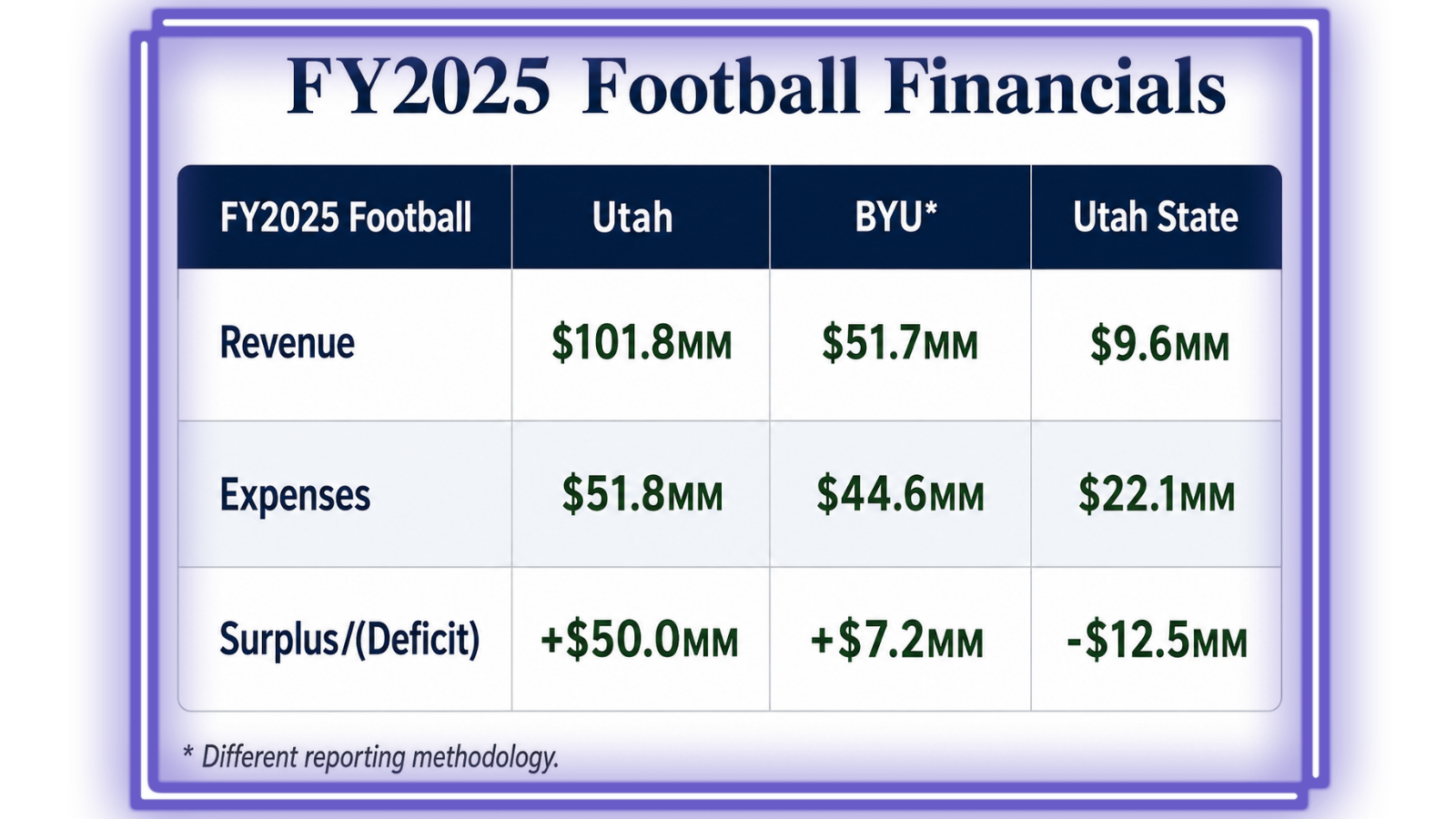
For Fiscal 2025 (ended June 30), the football program at the University of Utah reported $101.8 million in revenue against $51.8 million of expenses, producing a $50.0 million surplus, this according to the university's 98-page FY2025 NCAA financial report.
Conversely, according to College Sports Finance, Utah State was almost the inverse of the Ute Football program, with
🔹 $9.6 million in football revenue,
🔹 $22.1 million of expenses, and
🔹 A $12.5 million deficit.
Based upon data provided by College Factual, BYU's football program sat between its in-state FBS neighbors for FY25, with
🏈 ~$51.7 million in football revenue,
🏈 $44.6 million of expenses, and
🏈 A $7.2 million surplus.
But the BYU numbers require an asterisk.
As a private institution, Brigham Young University does not publish the same detailed NCAA financial filing obtainable for the UofU and USU, and conference and media revenues can be assigned differently by BYU.
As such, BYU's $51.7 million figure is not perfectly comparable with Utah's $101.8 million, even though both are members of the BIG12 Conference.
Even so, the contrast is striking:
The UofU's $50 Million Football Surplus
Here's where the financial story gets considerably more interesting, at least to me.
Although the Ute Football program produced that $50.0 million surplus in Fiscal 2025, the entire University of Utah Athletics Department finished FY2025 with a surplus of just $4.69 million.
In other words, football's profits at the UofU help finance the larger athletics enterprise at the university, something fairly common in college sports.
{AUTHOR'S NOTE: As noted in the UofU's FY24 NCAA Revenue and Expense Report, the Ute Football squad generated $79.1 million in FY2024 revenue and produced a surplus of $26.8 million.
{That means Ute Football nearly doubled its revenue surplus from FY24 to FY25.}
For the record, FY2025 ended 30 June 2025.
But one day later (1 July 2025), the economics changed.
Again.
That was the day that NCAA-participating institutions (like BYU, USU, and the UofU) needed to implement new financial standards in light of the court–mandated House v. NCAA settlement.
As noted in this USA Today article, the House v. NCAA settlement created direct school-to-athlete revenue sharing, with the first-year maximum set at $20.5 million per institution.
For the current 2026–27 academic year, that ceiling has increased to about $21.3 million.
And yet, Utah Athletics retained less than $5 million of surplus during FY2025, while the new college-sports marketplace immediately introduced a potential $20 million-plus annual player-compensation obligation for schools wanting to compete at the highest level.
Suddenly, the UofU's pursuit of outside capital for its Athletics Department may make more sense, even in light of the explanation of how Private Equity works by Stephen Schwarzman, CEO, Chairman, and Co-Founder of Blackstone Group.
Blackstone is the largest financial institution in the world, and as Schwarzman succinctly explains, the mission of P.E. firms is
🟢 To raise money,
🟢 Find entities to acquire (or invest in),
🟢 Run them better than they have been run before, and then
🟢 Sell said firms
"... to make a lot of money for our investors."
As reported last December by Utah Money Watch in "A Promised $500 Million Infusion Thrusts Ute Athletics to the Forefront of Collegiate Sports and Prevents its Slide into Second Tier Irrelevance," UofU leaders developed a for-profit commercial structure, coupled with a private-capital strategy.
This approach was envisioned as an effort to bring as much as $500 million-plus into the Utah Athletics ecosystem over time.
That plan moved from concept to execution in June when the UofU finalized its partnership with New York, New York-based Otro Capital and created Crimson Brand Partners, which began operations July 1st with the mandate to expand and manage commercial activities around Utah Athletics.
Financial terms of the UofU / Otro agreement were not disclosed at that time.
Why is this important? Because although
Ute Football can be wildly profitable, it appears that Utah Athletics needs substantially more money to finance 19 sports and compete nationally.
Paying the Players
On a separate yet related point, it's important to remember that revenue-sharing is not NIL.
Revenue-sharing money comes directly from the university.
Conversely, NIL monies come from legitimate third parties compensating athletes for commercial use of their Name, Image and Likeness.
BYU itself makes that distinction explicitly.
For 2026, U$W's best current estimates of football player-compensation resources for FBS teams in the state look something like this:
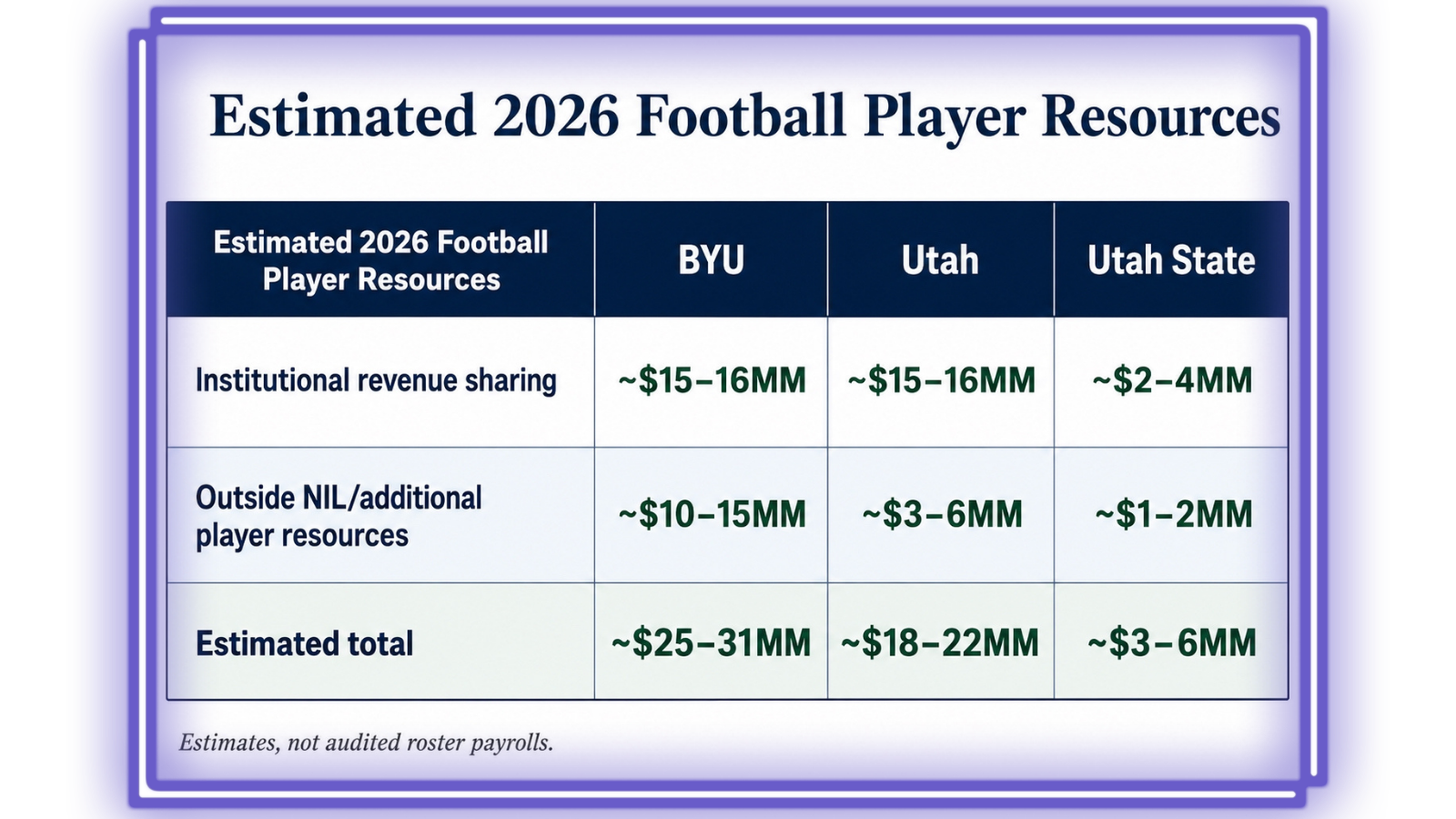
To be clear, these are estimates, not audited roster payrolls, but BYU's numbers are particularly noteworthy.
When Kalani Sitake rejected interest from Penn State University late last year and remained in Provo, On3 reported that BYU was committing another $10 million to $15 million in NIL resources to football on top of its revenue-sharing commitment.
The UofU is also operating at serious Power Four levels, although first-year head coach Morgan Scalley has acknowledged in a Deseret News interview that Utah is not among the emerging programs assembling $40 million-plus rosters.
And then there's Utah State.
Bottom line, the Aggies simply cannot play the same financial game, at least not today.
But USU supporters did raise over $1.5 million in cash and commitments for USU athletes during its 2025 Match Madness NIL campaign through the Blue A Collective.
This means that HC Bronco Mendenhall now gets to test whether coaching, development and roster efficiency can narrow at least some of that financial gap.
So What Should All that Money Buy this Season?
The BYU Cougars began the 2026 preseason ranked No. 14 in the Associated Press poll, while the Utes started at No. 21.
{AUTHOR'S NOTE: Utah State is not ranked by the A.P. voters, but ESPN's College Football Power Index 2026 places the Aggies at 98th out of 138 FBS football teams this year.}
BetMGM set its regular-season win total prediction for both ranked, in-state programs at 8.5 games apiece, with sports bookies placing odds that Utah State will garner just 5 wins this season.
But perhaps the more interesting U$W question is this:
Which football squad in the state of Utah will produce the best ROI dollars during the 2026 season?
If BYU deploys $28 million in player resources and wins nine regular-season games this year, that's about $3.1 million of player compensation per victory.
Conversely, if Utah deploys $20 million and wins nine, that's approximately $2.2 million per victory.
And if Utah State deploys $5 million and Bronco somehow produces five wins? That's roughly $1 million per victory.
Obviously, these figures do not represent the total cost of producing a football win.
But as simple measurements of roster-capital efficiency? Perhaps.
Regardless, the 2026 CFB season could be fascinating.
Your Turn: Prognosticate Away
Each of Utah's three FBS programs has 12 regular-season games ahead. So ... before the UofU kicks off Thursday night, you make the call:
What will each team's record be this season?
BYU: ___ – ___
Utah: ___ – ___
Utah State: ___ – ___
Predict one, predict two, or predict all three.
As for me, I'll give my prediction for BYU through my royal-tinted glasses:
- Regular season, 11-1 (11 wins against 1 loss), with a regular season loss to the UofU Utes at Rice-Eccles Stadium;
- Big 12 Conference champion, against either Houston or Utah; and
- A first-round victory in the CFP Tourney before losing in the second round.
And for bonus points, here's a follow-up question:
Which Utah-based football program will generate the best return on its gridiron investment in 2026?
The accountants, athletic departments, donors and NIL partners have already put tens of millions of dollars on the scoreboard.
Beginning Thursday night, the players start putting up scoreboard numbers that fans care about most: Wins and Losses.
Simply put,
✅ Go Cougs!!!
✅ Go Utes!!!
✅ Go Aggies!!!
Publisher's Note
This writeup was originally published and distributed to our Subscribers at approximately 1:20pm MT on Wednesday, 02 September8 2026.
However, if this report/article came to your attention sometime after this date/time and you'd like to change that, then (to become a subscriber), please
1. Click on a "Subscribe" button on any Utah Money Watch webpage (visit www.UtahMoneyWatch.com),
2. Enter in your name in the proper field in the popup window that appears on-screen, and
3. Enter your preferred email address in the proper field too.
That's it. Thanks.
Team Utah Money Watch



Comments ()