
Five Years After Opening a $286 Million Plant in Eagle Mountain, Utah, Tyson Foods is Shutting it Down and Eliminating 723 Utah Jobs in the Process

EXECUTIVE SUMMARY
✅ Five years after beginning production at an over $285 million meat-packaging plant in Eagle Mountain, Tyson Foods will permanently close the facility, eliminating 723 Utah jobs.
✅ Tyson opened the 600,000-square-foot facility in August 2021 as a highly automated “case-ready” meat plant, one Food Engineering named as its 2022 Tier 2 Plant of the Year winner.
✅ When Tyson announced the project, it projected 800-plus initial jobs, potentially 1,200 total positions, $44 million in annual local payroll, and a Utah economic impact of $1 billion during its first decade.
✅ As such, the State of Utah approved Tyson for up to $5.26 million in post-performance, state tax credits, plus a $300,000 infrastructure grant.
17 August 2026 — EAGLE MOUNTAIN, Utah — Five years ago, Tyson Foods began operating one of the most technologically advanced meat-processing plants in America in the City of Eagle Mountain, and the details were impressive:
🔺 Nearly $300 million invested,
🔺 600,000 square feet,
🔺 Over 800 initial jobs planned,
🔺 Growing to potentially 1,200 employees, and
🔺 Projections of more than $1 billion in Utah economic impact during its first decade.
But now, POOF!
Tyson announced last Thursday that it will permanently close its case-ready meat facility in Eagle Mountain as part of a broader restructuring of its U.S. beef business, eliminating 723 Utah jobs in the process.
As required by law, the company filed a WARN Notice on 13 August 2026 with the Utah Department of Workforce Services stating that 723 employees will be laid-off, with the shutdown expected on or around Oct. 12.
{AUTHOR'S NOTE: WARN regulations require employers to provide a minimum 60-day advance notice if they plan to eliminate 100 or more positions at one time.}
Clearly, the job losses alone make this a significant Utah business story.
But it is the monetary impact, and the remarkably short lifespan of the $286 million investment, that makes Tyson's decision especially noteworthy.
A Bold $286 Million Investment, But Five Years Later, "Adios."
According to Utah Money Watch research, Tyson selected Eagle Mountain in 2019 for a new “case-ready” beef-and-pork operation.
Livestock would not be slaughtered there.
Instead, large cuts of meat processed elsewhere would arrive at Eagle Mountain to be sliced, ground, packaged, weighed and labeled into consumer-ready products bound for grocery-store meat cases.
When Tyson broke ground in October 2019, the company projected an annual local payroll growing to approximately $44 million.
In fact, in the company announcement at the time, Tyson and Utah officials also projected approximately $27 million in new state tax revenues and more than $1 billion in economic impact during the project's first 10 years. Production began in August 2021.
To be clear, this was not some obsolete industrial plant waiting to become economically irrelevant; rather, this was a purpose-built operation.
Built on roughly 80 acres, the facility incorporated
▪️ Extensive automation,
▪️ Robotics,
▪️ Sophisticated cutting and packaging equipment,
▪️ Advanced refrigeration, and
▪️ Real-time production systems.
In fact, roughly a year after operations started at the plant, Food Engineering described Tyson's Eagle Mountain facilities as
“... one of the most technically advanced food processing plants in the country”
and named it the publication's 2022 Tier 2 Plant of the Year winner.
But now, five years after production began, Tyson is telling its employees, Eagle Mountain City, and the State of Utah "Adios."
The Promised Utah Incentives
According to Board materials published by the Governor's Office of Economic Development on 11 April 2019, the original agreement projected $27.79 million in new state tax revenues over a 10-year period.
As a result, GOED authorized the Tyson subsidiary, Tyson Fresh Meats, to earn up to $5,258,324 in post-performance Economic Development Tax Increment Financing credits (aka, after-the-fact EDTIF tax credits), plus an additional $300,000 post-performance infrastructure grant.
According to The Salt Lake Tribune, Tyson ultimately received only 25–50% of the state tax credit it was eligible to earn before announcing the closure.
As such, Tyson is leaving Utah well before the original 10-year economic-development window runs its course.
That detail also illustrates precisely why Utah structures many corporate incentives as post-performance benefits instead of upfront subsidies:
- When promised economic activity ends early,
- Taxpayer exposure can end early as well.
Tyson Claims it Has a Beef Problem
As noted in last week's news release from Tyson, it suggested that Eagle Mountain and Tyson employees are being caught in a much larger national problem rather than suffering from a uniquely Utah one.
According to Tyson, the reason for the coming closures of the Eagle Mountain facility (and others), plus the company's restructuring of its beef business, is due to
"... one of the most historic cattle shortages the country has ever experienced."
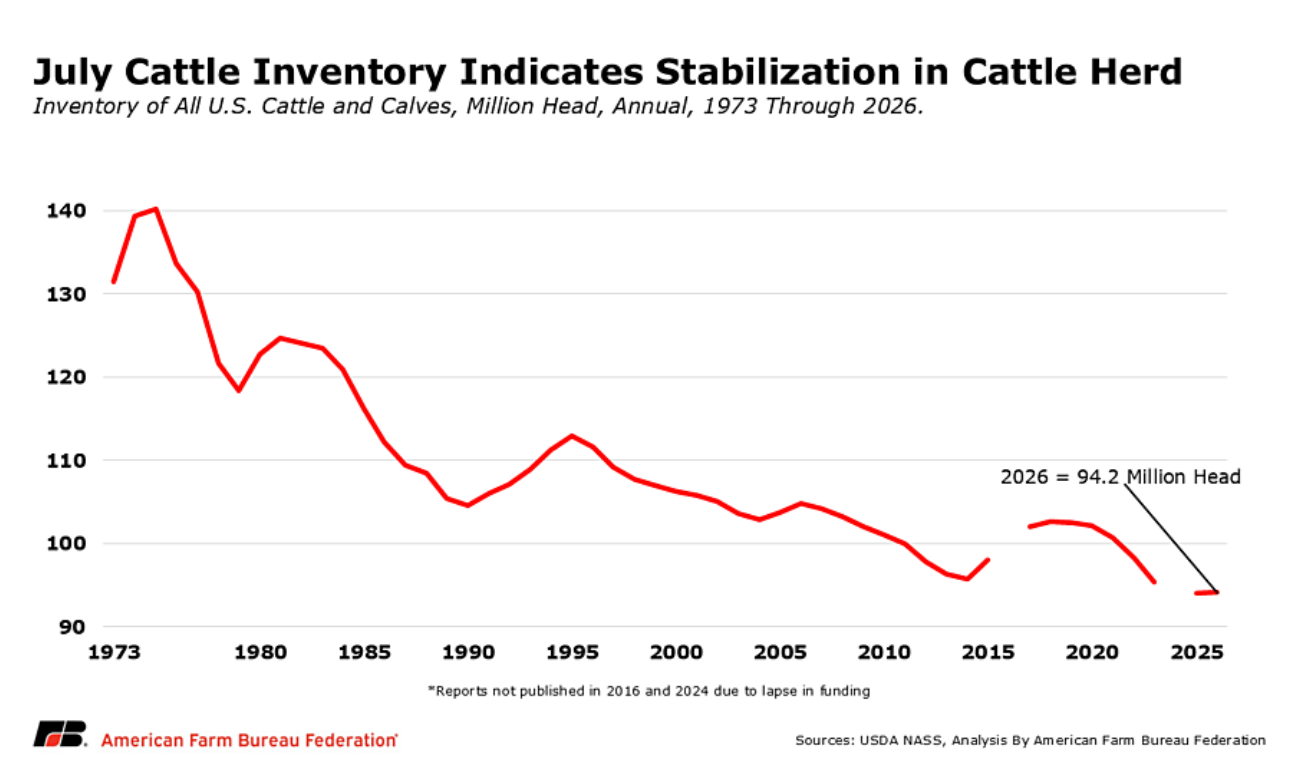
This claim was offset somewhat by the American Farm Bureau Federation in its July 2026 Farm Bureau Intel report that said that
"U.S. cattle herd shows signs of stabilization,"
with the total population increasing by 200,000 of all cattle and calves, up to 94.2 million head as of 1 July 2026.
However, as the American Farm Bureau report noted, this was the first time since 2018 that U.S. cattle inventory has seen a monthly increase on a Year-over-Year basis.
In analyzing the data published in July by the U.S. Department of Agriculture, the American Farm Bureau report stated that the 3% increase in beef replacement heifers
“... represents the first meaningful sign of heifer retention and potential herd rebuilding in nearly a decade.”
Locally, Spencer Gibbons, CEO of the Utah Farm Bureau Federation, noted that Utah weather conditions continue to challenge the state's agriculture sector.
“It is hard to see something like this happen, because the processing sector has traditionally been a bottleneck here in Utah. The drought continues to put pressure on farmers and ranchers to sell off their cattle rather than keeping replacements (and) allowing the national herd grow. But there are signs that is stabilizing some. This is a multi-year cycle though, so it won’t be fixed overnight."
He continued:
“There is also optimism with some efforts recently announced by Governor Cox and the Utah Department of Agriculture & Food with its Food Security Grants. These aim at helping grow small and mid-sized food production and processing businesses throughout Utah, and expanding options for Utah food to get to Utah consumers.”

{NOTE: The Utah Farm Bureau is the largest general farm organization in Utah and represents both farmers and ranchers.}
So What Happens to a Soon-to-be-Empty, Nearly New, $286 Million, 600,000-Square-Foot Meat Packaging Plant?
Come Tyson's planned departure in mid-October, the City of Eagle Mountain will still be home to a
— 600,000-square-foot,
— Highly automated,
— State-of-the-art food-packaging facility,
— Sitting on approximately 80 acres,
— One with nearly $300 million originally invested in it less than a decade ago.
To me it raises a ton of questions:
🔷 Will Tyson sell it?
🔷 Or lease it to another food company?
🔷 Can the plant be adapted for another type of manufacturing?
🔷 And, arguably, can someone replace a meaningful portion of those 723 jobs?
One thing for sure, I can guarantee you that state and local officials are scrambling to ensure that facility does not sit vacant for long.
And I'm doubly sure this holds true for enterprising entrepreneurs and investors as well.
For local firms in the food and beverage industry struggling to find employees, I would reach-out to the City of Eagle Mountain and Tyson Foods today.
And to 723 Utah-based Tyson employees, thoughts and prayers from the Utah Money Watch team, plus an added: "Vaya con Dios."
Publisher's Note
This writeup was originally published and distributed to our Subscribers at approximately 09:10am MT on Monday, 17 August 2026.
However, if this report/article came to your attention sometime after this date/time and you'd like to change that, then (to become a subscriber), please
1. Click on a "Subscribe" button on any Utah Money Watch webpage (visit www.UtahMoneyWatch.com),
2. Enter in your name in the proper field in the popup window that appears on-screen, and
3. Enter your preferred email address in the proper field too.
That's it. Thanks.
Team Utah Money Watch

Comments ()