
Utah’s $30 Million Bankruptcy Acquisition of "Certain" US Magnesium Assets Carries a Superfund Liability Likely 3X Higher or More
Cleanup and reclamation costs of the US Magnesium "Superfund" site on the borders of the Great Salt Lake will likely surpass $100MM.

The 145,000-acre-feet of Great Salt Lake water rights may be the prize, but both Wells Fargo’s "DIP" lien and the underlying EPA Superfund liability remain unresolved
Salt Lake City — 19 February 2026 — The State of Utah has closed on a $30 million bankruptcy acquisition of "certain" key assets tied to the former US Magnesium operation at the Great Salt Lake.
And yet, while the State has correctly approached this deal as a water-first play, the reality is that US Magnesium's 4,500 acres now owned by the State are a known "Superfund" site, with most media outlets pegging cleanup and reclamation costs of that land to be north of $100 million.
That's why I began digging into the background of US Magnesium and the massive mess it created on the western border of the Great Salt Lake to try and get to the bottom of who, or what, holds the actual liability for this Superfund site.
When I spoke Tuesday evening with Director Jamie Barnes of Utah's Division of Forestry, Fire and State Lands, she confirmed that virtually everything reported about the acquisition by both local and national media outlets was correct.

This included
- The scope of the "certain assets" Utah has acquired,
- The magnitude of water-rights accompanying this purchase, and
- The existence of the Wells Fargo lien structure tied to the bankruptcy process.
What Utah Bought for $30 million
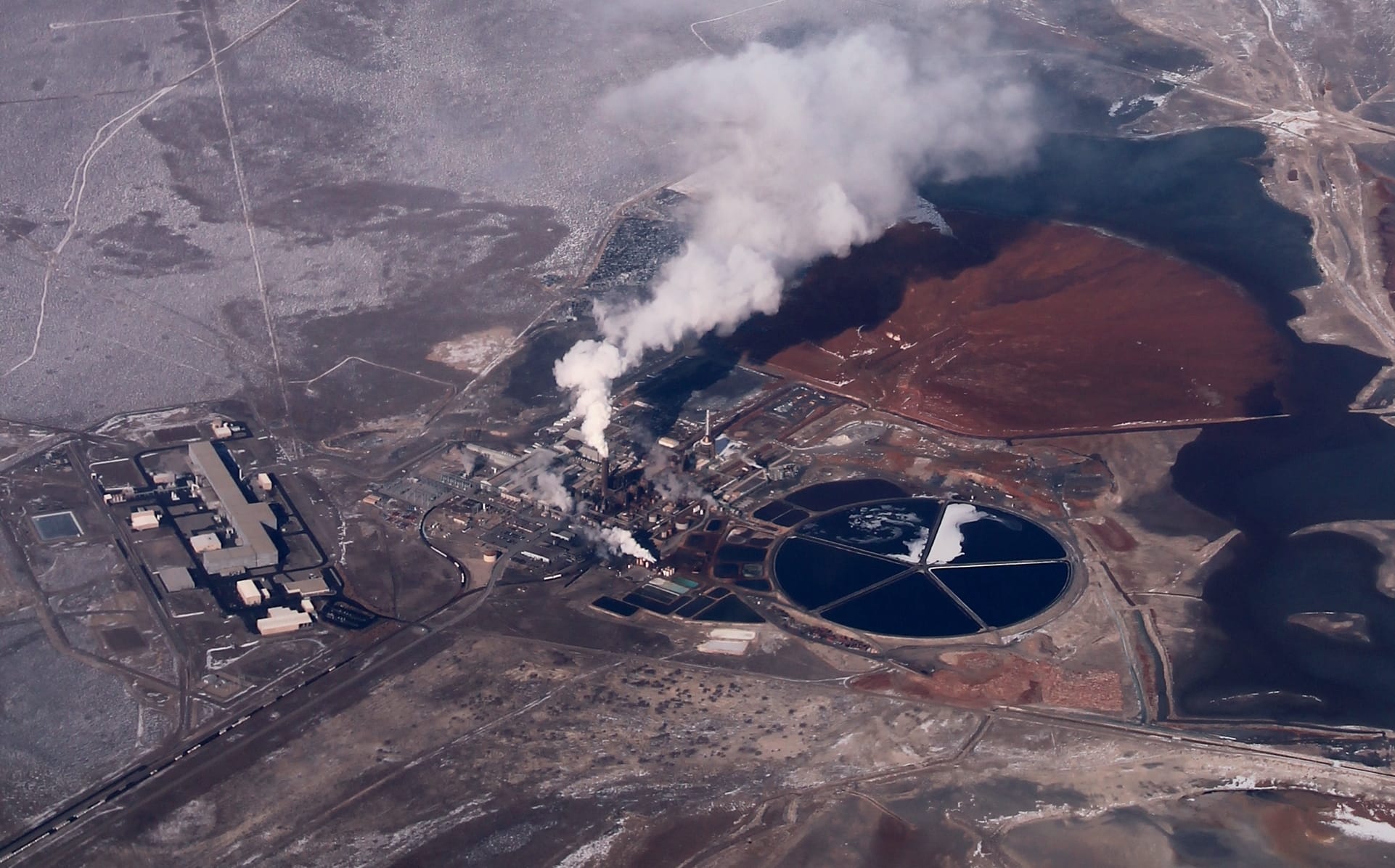
The US Magnesium site sits roughly 15 miles north of Interstate 80 (by road) and 40 miles due east of Salt Lake City in Rowley, a so-called "company town" built from scratch on the western shore of the Great Salt Lake in Tooele County when the predecessor firm to US Magnesium was first formed in 1975.
As per Dir. Barnes and the previously reported descriptions of the asset package, Utah’s purchase delivers control of the site’s two most valuable levers, namely
🔹 Roughly 4,500 acres of US Magnesium land and related facilities, plus
🔹 The 145,000-acre-feet of annual water rights tied to the Great Salt Lake.
However, as explained to me by Dir. Barnes, the State’s posture about this purchase is not subtle.
As a government and a people, Utah clearly wants more water to stay in the lake.
Both also want a direct hand in what happens next on a site that has been a recurring environmental and regulatory flashpoint for decades.
Two Strategic Issues Still Unresolved
As Barnes explained, the State is in active discussions with Wells Fargo to work out how the bank’s debtor-in-possession (DIP) lien position is addressed relative to certain assets tied to the former US Magnesium facilities.
{AUTHOR'S NOTE: DIP financing keeps a Chapter 11 debtor operating, and such Debtor-in-Possession lenders usually receive court-approved super-priority liens. In an asset sale, those liens are commonly paid off from sale proceeds so the buyer can take the assets free and clear.}
Additionally, Barnes also told me that the State is investigating who (or what) will ultimately carry reclamation liability for the Superfund site, which is a question that could become very expensive very quickly.
The Superfund Issue Utah Cannot Escape
By way of background, US Magnesium filed for Chapter 11 protection in the U.S. Bankruptcy Court for the District of Delaware on 10 September 2025.
And yet, US Magnesium and its parent company have struggled financially for decades.
For example, since 4 November 2009, the U.S. Environmental Protection Agency has formally named the US Magnesium facility and surrounding waste-disposal areas on the Great Salt Lake’s edge in Tooele County as an active Superfund site under both CERCLA and RCRA regulations.
{AUTHOR’S NOTE: The Comprehensive Environmental Response, Compensation and Liability Act (CERCLA), commonly called Superfund, is the federal statute that governs the cleanup of contaminated sites and the allocation of liability for response costs. Conversely, the Resource Conservation and Recovery Act (RCRA) is the federal statute that governs hazardous waste management, including requirements around handling, treatment, storage, disposal, and corrective action.}
Obviously, a Superfund designation carries with it financial responsibility for cleanup and reclamation costs.
Federal enforcement history is central to the financial risk associated with the acquired land and surrounding areas because US Magnesium entered binding federal cleanup and compliance commitments with the U.S. Environmental Protection Agency in June 2021.

However, both federal and state regulators found in 2024 and 2025 that the company did not satisfy those commitments.
Is the Cleanup Cost the Real Story Here?
Clearly the 145,000-acre-feet of water is the headline number tied to Utah's $30 million purchase, and for good reason, given both the environmental and economic impact of the Great Salt Lake on the entire Wasatch Front, let alone the entire state.
However, the costs for reclaiming the Superfund site on the ~4,500 acres at the former US Magnesium location may actually become the leverage point for this acquisition.
As Dir. Barnes explained, the State went into the bidding process to acquire the US Magnesium assets with its "eyes wide open," figuratively, of course.
And yet, if reclamation efforts ultimately escalate into nine figures ($100 million or greater), the risk to Utah's taxpayers, both human and corporate, rise dramatically.
This makes the question of this financial overhang paramount, potentially even more so than the 145,000 acre-feet of Great Salt Lake water that Utah now owns.
From my perspective, however, penetrating the murky morass of legal liability post-bankruptcy proceedings is so convoluted that I am convinced that the decision on final financial responsibilities will ultimately fall to the U.S. Department of Justice.
This was doubly clear to me following my research as I uncovered that the prior sole equity owner of US Magnesium is a New York City-based firm known as The Renco Group, an organization that may still hold ownership of other US Magnesium assets.
What is Renco Group? And who is Ira Rennert?
By way of background, the Renco Group is a privately held, New York-based holding company that has long been associated in public records and reporting with industrial and metals-related assets.
This includes historical ties to the Great Salt Lake operations underlying what has been known for years as US Magnesium, which (as multiple media organizations have reported) has been buried under multiple corporate ownership layers.
According to Wikipedia, Renco Group was formed in 1975 and is described as having interests that include mining and metals production, as well as other industrial businesses.
In other words, it's a so-called "diversified" organization.
Because Renco Group is privately held, top-line revenue is not disclosed as it would be were it a publicly traded company.

Forbes further reports that Rennert's ownership/control of Renco Group has earned him an estimated net worth of $3.8 billion.
However, where this all got super interesting to me was outlined in the final Asset Purchase Agreement in the US Magnesium bankruptcy proceedings.
In researching the APA I learned that there are assets that were NOT sold to the State of Utah, assets that are still tied-up in Bankruptcy Court and may, potentially, inure rights (and potentially liabilities) back to US Magnesium's owner.
So ... knowing that the Chapter 11 bankruptcy proceedings are not completed, my question is this:
Who actually owns these remaining US Magnesium assets?
And who, then, has ultimate liability for the Superfund site?
For better or worse, these are questions yet to be determined in Court.
What Does this All Mean?
To me the bottom line is straightforward — clearly Utah bought control of "certain assets" previously owned by US Magnesium (primarily water rights, the land, and the accompanying facilities) through Bankruptcy Court, as details of which are found in the APA.
But what I also feel the State bought was time:
🔹 Time to help alleviate some of the overarching water challenges facing the Great Salt Lake, as well as
🔹 Time to research and determine legal liability for cleaning-up the US Magnesium Superfund site.
Then again, it's also clear that the State also bought exposure to one of the most complicated environmental balance sheets in Utah. Ever.
But at some point, either someone or some thing (aka, some entity) is going to have to "Pay Up" to clean and restore said Superfund site in Tooele County.
Hence, if US Magnesium could not or would not execute its previously agreed to cleanup obligations, and if the cleanup costs balloon beyond $100 million, the natural incentive for both Federal and State regulators (and Utah's Department of Natural Resources) is to look for other responsible deep pockets as allowed by the law.
Does that mean Renco Group and/or Rennert?
Clearly, that's the $100+ million question, right?
In other words, the aspect of legal liability behind this $30 million acquisition is something to definitely keep an eye on as details on Utah's purchase, and the ultimate responsibility/liability for the Superfund clean-up, continue to be explored and ironed-out.
Publisher's Note
This writeup was originally published and distributed to our Subscribers at approximately 08:50am MT on Thursday, 19 February 2026.
However, if this report/article came to your attention sometime after this date/time and you'd like to change that, then (to become a subscriber), please
1. Click on a "Subscribe" button on any Utah Money Watch webpage (visit www.UtahMoneyWatch.com),
2. Enter in your name in the proper field in the popup window that appears on-screen, and
3. Enter your preferred email address in the proper field too.
That's it. Thanks.
Team Utah Money Watch

_(cropped).jpg)
Comments ()