PART ONE: From Roy to Layton to Magna — Northrop Grumman's Latest $43.86 Million Navy Contract Highlights Utah's Role in America's Nuclear Triad
Executive Summary
✅ The U.S. Navy recently awarded Northrop Grumman a $43.86 million contract for manufacturing infrastructure in Magna, Utah supporting its Trident II missile program, with the entire contract amount obligated at the time of the award.
✅ This Magna contract follows Northrop's July groundbreaking on a new building in Roy supporting the Sentinel missile program and its September opening of a new manufacturing facility in Layton supporting the B-21 Raider bomber program.
✅ Collectively, these three developments demonstrate the role Northrop Grumman's Utah operations play in supporting all three legs of America's nuclear triad: land, air and sea.
✅ Northrop directly employs over 11,000 Utahns today, works with more than 600 Utah suppliers, and reportedly generates more than $12.4 billion in economic impact in the state.
ROY, LAYTON and MAGNA, Utah — 25 November 2026 — In the span of 101 days, three separate developments involving Northrop Grumman (NYSE: NOC) have highlighted the increasingly important role the company's Utah operations are playing in modernizing America's nuclear arsenal.
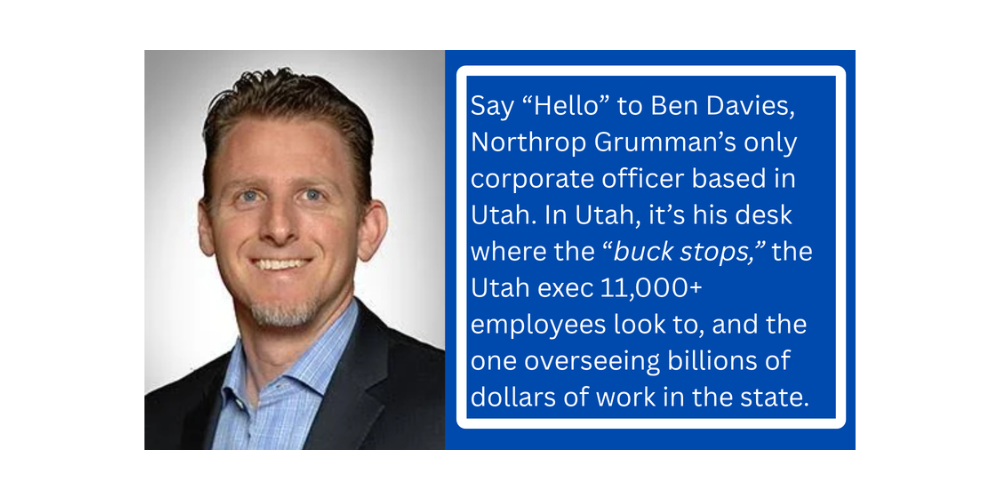
{AUTHOR'S NOTE: The top Northrop executive leading these developments in Utah and the only corporate executive based in the state? None other than Benjamin R. ("Ben") Davies, as shown in the "hero image" at the top of this article. Davies is a Northrop Grumman Corporate Vice President and President of Northrop Grumman Defense Systems.}
The latest of these developments tied to Utah occurred on 23 October 2026 when the U.S. Navy awarded Northrop a $43,856,500 contract for new manufacturing infrastructure in Magna in support of its submarine-launched Trident II missile program.
In other words, the U.S. Navy is paying Northrop to design design new manufacturing infrastructure in Magna, Utah for future Trident II missile work.
Unlike some federal defense contracts where only a portion of the announced contract value is obligated at the time of the award, the Navy "obligated" the entire $43.86 million when it awarded the firm-fixed-price contract.
Additionally, according to Public Technologies' reporting on the October 23rd federal contract announcement, all work associated with the contract will be performed in Magna, with completion anticipated by 31 August 2028.
But as financially significant as this latest contract is, its greater significance becomes apparent when viewed alongside two other developments involving Northrop Grumman in Utah from earlier this year.
Roy: Modernizing America's Land-Based Nuclear Deterrent
On 14 July 2026, executives with Northrop Grumman broke ground on the company's new Legacy Building at its Roy Innovation Center (RIC).
Slated for completion in 2028, the Legacy Building will expand the RIC campus to six buildings encompassing more than 1.1 million square feet of office space, with sufficient capacity for more than 5,000 employees.
The Roy expansion will support, among other programs, the U.S. Air Force's next-generation Sentinel intercontinental ballistic missile (ICBM) program, which is designed to replace America's aging Minuteman III missiles.
And the money flowing into the Sentinel program is substantial.
According to Northrop's third quarter 2026 financial results, as filed with the U.S. Securities and Exchange Commission on October 20th, the company reported
- $2 billion in new Sentinel contract awards during the quarter, and
- A $180 million year-over-year increase in Sentinel-related quarterly sales.
Although neither figure represents Utah-specific financial activity, the company's decision to expand its Roy campus coincides with growing expenditures on the Sentinel program.
Layton: Expanding Manufacturing Capacity for America's Next Nuclear-Capable Bomber
Less than two months after breaking ground in Roy, Northrop Grumman executives gathered in Layton on 9 September 2026 to celebrate the opening of the company's new East Gate 3 manufacturing facility tied to Hill Air Force Base.
The facility will support increased production of the B-21 Raider, the Air Force's next-generation stealth bomber designed for both conventional and nuclear missions.
According to Northrop, its East Gate campus will ultimately encompass approximately 845,000 square feet of advanced aircraft manufacturing space, with sufficient capacity to accommodate 1,500 employees by 2032.
Additionally, with the opening of East Gate 3, the company's combined manufacturing footprint in Clearfield and Layton now exceeds two million square feet.
To put that manufacturing footprint into perspective, that's the equivalent of more than 45 acres of floor space.
Magna: Investing in Infrastructure for America's Sea-Based Nuclear Deterrent
Which brings us back to the Navy's October 23rd contract.
According to the original federal award notice, the broader infrastructure project encompasses the design, construction and commissioning of specialized manufacturing facilities.
The accompanying federal contract announcement, however, specifically identifies design work as the purpose of the $43.86 million award.
As such, additional federal expenditures associated with the eventual construction and commissioning of these facilities are a possibility.
There is also a much longer financial horizon to consider.
The Navy has established a strategic modernization and sustainment initiative known as Sea Based Strategic Deterrence 2084.
Yes, 2084.
That's nearly six decades from now.
Although the initiative does not guarantee future contract awards for Northrop Grumman's Utah operations, it provides some perspective on the anticipated longevity of America's sea-based nuclear deterrence programs.
The Financial Implications for Utah's National Security Ecosystem
Beyond its more than 11,000 direct employees in Utah, Northrop Grumman works with more than 600 Utah suppliers.
Additionally, the company cites research indicating that its operations support more than 46,000 jobs throughout Utah and generate more than $12.4 billion in economic impact.
In February 2024, the then-named Utah Governor's Office of Economic Opportunity (GOEO) announced a post-performance tax incentive tied to the company's projected addition of more than 1,200 new jobs in northern Utah over a 20-year period.
The state's projections associated with that expansion also included more than $350 million in new state tax revenues.
For Utah's construction companies, engineering firms, precision manufacturers, materials suppliers, technology developers and professional services providers, the implications of continued federal investments in America's nuclear deterrence capabilities extend well beyond Northrop's payroll.
And while America's nuclear triad consists of three distinct delivery systems, federal expenditures tied to modernizing and sustaining all three are finding their way into Utah's economy through a single defense contractor.
That's a remarkable concentration of National Security-related economic activity for a state with no coastline and no operational nuclear missile silos or strategic bomber bases.
And as we'll explore in Part Two of this series, Northrop Grumman is not the only major American defense contractor benefiting from new federal expenditures tied to America's nuclear deterrence capabilities that will translate into additional economic activity in Utah.
{AUTHOR'S NOTE: This is the first of a three-part Utah Money Watch series examining recent federal contract awards and their implications for Utah's National Security ecosystem.}
Publisher's Note
Utah Money Watch reports and analyzes companies, transactions, securities, valuations and financial outcomes for informational and journalistic purposes. Nothing published by Utah Money Watch is intended as individualized investment advice or as a recommendation to buy, sell, or hold any security.
As such, this writeup was originally published and distributed to our Subscribers at approximately 01:20pm MT on Wednesday, 25 November 2026.
However, if this report/article came to your attention sometime after this date/time and you'd like to change that, then (to become a Free Subscriber), please
1. Click on a "Subscribe" button on any Utah Money Watch webpage (visit www.UtahMoneyWatch.com),
2. Enter your name in the proper field in the popup window that appears on-screen, and
3. Enter your preferred email address in the proper field too.
That's it. You've now joined the ranks of our Free Subscribers.
So, thanks.
The Utah Money Watch Team


Comments ()