
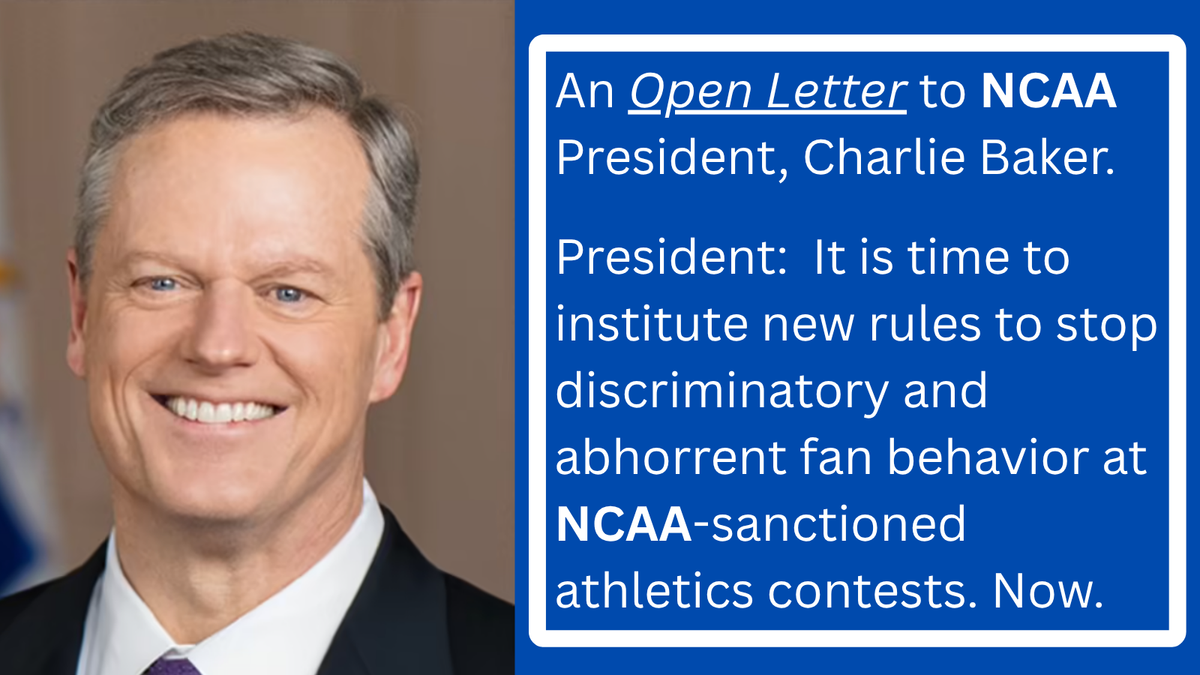
An Open Letter to NCAA President Charlie Baker: College Sports Needs a National Anti-Bigotry Rule with Real Consequences
23 September 2026 — LEHI, Utah
To: Charlie Baker, President, National Collegiate Athletic Association
Copies provided to: Members of the NCAA Board of Governors; and Commissioners/Executive Directors of the 32 NCAA Division I primary conferences
Dear President Baker:
Enough.
On Saturday, 19 September 2026, members of the Colorado State University student section repeatedly chanted “F— the Mormons” before and during the Rams' football game against Brigham Young University in Fort Collins, Colorado.
Colorado State apologized before the night was over, releasing a statement that said, in part:
“Mocking anyone’s faith has no place at CSU.”
Colorado State was right, but an apology is no longer enough:
⚫️ Not from Colorado State.
⚫️ Not from another university next month.
⚫️ Not from another athletic director after another basketball game.
⚫️ And not from another conference commissioner condemning conduct everyone already knows is wrong.
Why? Because fans and student sections have done so numerous times of late, in
⚫️ 2021 — The University of Southern California (USC);
⚫️ 2022 — The University of Oregon;
⚫️ 2024 — Providence College;
⚫️ 2025 — Three separate instances:
▪️ The University of Arizona,
▪️ The University of Colorado, and
▪️ The University of Cincinnati; as well as in
⚫️ 2026 — Two separate instances:
▪️ Oklahoma State University, and last week,
▪️ Colorado State University.
Eight institutions in roughly five years.
Colorado and Oklahoma State were each fined $50,000 by the Big 12 Conference, and the institutions apologized, and yet the behavior continues.
In other words, the current approach towards deterrence is not working.
I have spent more than four decades working professionally in public relations, corporate communications, crisis communications, and journalism. I understand both the importance and the limitations of an institutional apology.
An apology can acknowledge failure. It can express regret. It can begin rebuilding trust.
But when substantially the same conduct continues at institution after institution and year after year, communication is no longer the solution. Corrective action is.
This Is Bigger Than BYU
Although raised in the San Francisco Bay Area, I am a devout member of the Church of Jesus Christ of Latter-day Saints, someone who graduated from Brigham Young University who happens to live with his family in Utah today.
So yes, I take personally a chant that attacks individuals and groups of people because of their religion, especially Latter-day Saints.
But this cannot be an LDS rule; it must protect everyone.
Hence, when you replace “Mormons” with such names or terms as
⚫️ Jews,
⚫️ Muslims,
⚫️ Catholics,
⚫️ Baptists,
⚫️ Methodists,
⚫️ Black Americans,
⚫️ Hispanics,
⚫️ Asians,
⚫️ People with disabilities, or perhaps
⚫️ Members of some other identifiable group targeted because of
▪️ Who they are,
▪️ What they believe, or
▪️ The personal lifestyle choices they make,
it quickly becomes clear how hurtful, hateful, and discriminatory such language actually is.
The standard of how society responds to such attacks should not change. Then again, neither should our commitment to freedom of speech.
Personally, I value such freedom enormously. That is precisely why the policy I am proposing in this letter must be considered and drawn carefully.
As such, the NCAA should not become the profanity police.
In fact, people must remain free to criticize BYU, The Church of Jesus Christ of Latter-day Saints, Christianity, Judaism, Islam, atheism, university policies, political ideas, and virtually anything else.
Nevertheless, there is a clear and meaningful difference between shouting
⚫️ “F— BYU” and
⚫️ “F— the Mormons.”
The first is crude and arguably offensive sports trash talk directed at an opposing institution during an athletics contest.
The second, however, can quickly devolve into coordinated discriminatory conduct targeting people because of their religion.
However, to be clear, I am not calling for a 1984-like approach that punishes thought or prohibits criticism.
In fact, freedom of speech and freedom of expression do not mean an unlimited right to say or do anything, anywhere, under any circumstances. A ticketed athletics venue is not automatically a public forum merely because members of the public may purchase admission. Courts have recognized that even publicly owned sports venues may impose reasonable rules consistent with the purpose, safety and orderly operation of the facility.
And the NCAA already recognizes this principle in practice through its "Championships Fan Code of Conduct" for championship events, which authorizes intervention and ejection for certain disruptive and abusive spectator behavior. (See Appendix C, pp. 13–14)
As such, although a ticket provides admission to an event, it does not provide immunity from reasonable conditions governing conduct inside the venue.
This is why I believe it is incumbent on the NCAA and its member conferences and institutions to ...
Establish clear rules governing discriminatory crowd misconduct inside controlled athletic venues hosting contests involving NCAA member institutions, and enforce those rules consistently.
The Authority Already Exists
This is not a problem without authority, mind you.
The NCAA's own Constitution states that control and responsibility for intercollegiate athletics are exercised by the institution itself and by the division and conference of which it is a member. It also places ultimate responsibility for an athletics program with the institution's president or chancellor.
Separately, conferences possess their own sportsmanship and membership authority.
The Big 12 has already demonstrated that by fining the University of Colorado and Oklahoma State University $50,000 each following anti-Latter-day Saint chants.
Additionally, universities already control
⚫️ Their venues,
⚫️ Ticketing systems, and
⚫️ Student sections.
And the NCAA Board of Governors provides strategic leadership on Association-wide issues affecting all three NCAA divisions and oversees key Association-wide policy decisions affecting member schools and conferences.
In other words, I believe the missing ingredient is not authority. Rather, it is a coherent national system that actually uses such authority.
I am asking you, President Baker, to place this issue before the NCAA Board of Governors and use the leadership of your office to establish an Association-wide minimum standard, applicable across all three NCAA divisions, while allowing individual conferences to impose additional and/or more severe sanctions.
What the Policy Should Require
FIRST: Immediate intervention.
When qualifying discriminatory crowd misconduct begins, trained game-management and security personnel should intervene.
Identifiable offenders may be removed immediately.
If a coordinated chant or comparable act continues after warning, play should be stoppable and the offending seating section should be clearable when necessary.
At FBS football games and Division I basketball games, extensive
⚫️ Broadcast,
⚫️ In-stadium/arena, and
⚫️ Security video already exists.
Many student sections already have sufficient high-resolution camera coverage to permit reasonable identification after an incident. And relevant video, ticketing, and entry records should be preserved.
But no mandatory facial-recognition system is necessary.
Instead, human review of video, ticketing information, and eyewitness evidence can accomplish much of this work.
SECOND: Punish identifiable offenders.
Any enrolled student whose participation is established through reliable evidence and an appropriate review process should lose the privilege of attending NCAA member-hosted athletic events for a minimum of one year from the date of the offense.
Alumni, faculty, staff, administrators and other spectators found similarly responsible should face comparable venue sanctions, including longer or permanent bans for serious or repeated misconduct.
Stated more precisely: Immediate ejection is game management, while the prospect of longer punishment comes after review.
THIRD: Close the offending section.
This may be the most important provision of all.
When a qualifying mass-participation violation is reliably attributed to students or other institution-affiliated spectators concentrated in a defined seating section,
That section should lose its seats for the institution's next home contest in that sport.
A second verified violation by that section during the same season closes it for the next two home contests, while a third instance in the same section closes said section for at least three future home competitions.
Continued violations should likewise escalate from there, potentially through the remainder of the season.
Additionally, any unserved suspension would carry forward into the following season.
Naturally, the NCAA should take the lead in establishing objective criteria for determining
⚫️ Qualifying mass violations, and
⚫️ Considering a number of additional factors, such as
▪️ Participant concentration within a section(s),
▪️ Duration of an incident,
▪️ Repetition of an incident,
▪️ Audibility,
▪️ Available video and audio evidence, and
▪️ The institution's response.
I believe that this provision has the ability to change behavior before punishment ever becomes necessary.
Once students understand that discriminatory conduct by people around them can cost everyone their seats the next day, next Saturday, or next month, the section gains an immediate reason to police itself.
As such, should someone start a discriminatory chant, the people around that person have a reason to stop it and/or report the offending participants.
That is deterrence, with very personal involvement and consequences.
FOURTH: Impose institutional financial consequences.
There are three aspects to this recommended policy change.
A. For a qualifying Division I mass-participation violation, I propose a minimum $500,000 fine payable to a legally recognized nonprofit serving the community that was targeted.
B. I also propose an additional $500,000 fine payable through a lawful mechanism that benefits student-athletes at the institution that was attacked.
C. Subsequent mass-participation violations would see subsequently increased fines and payouts by the institutions where such violations occur, with the size of the increased payouts determined in advance by the NCAA and its member conferences.
Naturally, the NCAA would determine how the second payment noted above should be structured under current NIL and student-athlete compensation rules.
Separately, for Divisions II and III, the amounts can be scaled appropriately while remaining substantial enough to command institutional attention.
FIFTH: Impose competitive consequences when institutional failure becomes serious.
Forfeiture should be available, including retroactively.
But it should not be triggered by raw crowd size alone. That could invite manipulation by outsiders posing as supporters of the home institution.
Competitive sanctions should require reliable evidence that a qualifying number of participants were
⚫️ Students,
⚫️ Alumni,
⚫️ Employees, or
⚫️ Other demonstrably affiliated supporters.
Such competitive sanctions could/should also be combined with aggravating circumstances, such as
⚫️ Repetition after a prior institutional sanction,
⚫️ Continuation after an official warning or intervention, and/or
⚫️ Documented failure by game management to act.
Loss of NCAA postseason hosting privileges should be available as an intermediate penalty.
And nothing in the NCAA policy should prevent a conference from imposing stronger sanctions under its own sportsmanship rules.
SIXTH: Require transparency.
Every qualifying incident should be reported to the NCAA and the applicable conference within 72 hours, and it is crucial that relevant evidence be preserved.
The institution where the violation occurred should publicly disclose
⚫️ What happened,
⚫️ What immediate intervention occurred,
⚫️ How individuals were identified,
⚫️ What sanctions followed, and
⚫️ What corrective measures will be in place before the next home contest,
all consistent with appropriate privacy laws and regulations.
And as noted above, clearly this report should be made public.
In other words, no more apology, news cycle, institutional amnesia, repeat.
The Point Is to Change Behavior
The NCAA has long had nondiscrimination principles in place, along with
⚫️ Fan-conduct expectations, while
⚫️ Most conferences have already instituted sportsmanship rules, and
⚫️ Universities and colleges remove spectators from venues when appropriate.
What is missing, however, is an integrated system of escalating consequences, plus the willingness and the fortitude to follow through and act on such consequences.
As a sports fanatic, I suspect that most students who know participation in discriminatory activities during a sporting event could cost a year of college sports attendance may think twice.
Similarly, a student section that knows a verified mass violation will cost everyone the next home game has a reason to police itself.
And in this age of growing financial expenditures, I'm confident that most athletic departments facing seven-figure financial consequences will prepare to address potential public discriminatory actions differently.
And last but not least, a university president who knows that repeated institutional failure could cost postseason hosting privileges, or even a victory, will make certain someone inside the stadium has both the responsibility and authority to act.
Decisively.
That is how incentives work, and both incentives and disincentives change behavior.
President Baker, college athletics does not need another statement saying racism, religious bigotry, and discriminatory harassment are inconsistent with higher education.
We know this already.
Instead, what college athletics needs is a new rule:
⚫️ A rule that people understand;
⚫️ A rule universities must enforce;
⚫️ A rule that protects everyone equally; and
⚫️ A rule with consequences serious enough that doing nothing is no longer the easiest option.
Please lead the NCAA and its membership in creating that rule. Now.
Sincerely and respectfully,
David Politis
Editor & Publisher, Utah Money Watch,
Brigham Young University (Class of 1997),
A devoted fan of college athletics, and
A devout member of The Church of Jesus Christ of Latter-day Saints
P.S. To be clear, what I have proposed within this letter is not theoretical. In 2019, the Utah Jazz investigated abusive conduct directed at Oklahoma City Thunder star Russell Westbrook using video review and eyewitness accounts. By doing so, they quickly identified the spectator and permanently banned him from all events at the arena.
Additionally, the NCAA itself already uses technology plus human review to identify abusive actors. In fact, through its monitoring program during the 2025 March Madness Division I men's and women's basketball tournaments, the NCAA tracked/reviewed over 1 million online posts and comments, 103 threatening accounts were investigated, and 10 matters were referred to law enforcement.
The first example happened inside a professional sports setting based upon fan behavior in an NBA arena, while the other came from your own organization. In other words, the tools exist, and the investigative model exists as well.
I ask that you now use them where the abuse is happening: In the stands. dlp
cc: Members of the NCAA Board of Governors; and
Commissioners/Executive Directors of the 32 NCAA Division I primary
conferences
Publisher's Note
Utah Money Watch reports and analyzes companies, transactions, securities, valuations and financial outcomes for informational and journalistic purposes. Nothing published by Utah Money Watch is intended as individualized investment advice or as a recommendation to buy, sell, or hold any security.
On 14 July 2026, the U.S. Government Accountability Office published "College Athletics: Most Programs Spend More Than They Generate in Revenue." In its report, the GAO reported that "Division I college athletic programs, the highest competitive level, spent $20.8 billion in the 2023-2024 academic year." Such a financial impact across collegiate athletics, including within the state of Utah, is (in part) why we published this writeup today.
As such, this writeup was originally published and distributed to our Subscribers at approximately 8:45am MT on Wednesday, 23 September 2026.
However, if this report/article came to your attention sometime after this date/time and you'd like to change that, then (to become a Free Subscriber), please
1. Click on a "Subscribe" button on any Utah Money Watch webpage (visit www.UtahMoneyWatch.com),
2. Enter your name in the proper field in the popup window that appears on-screen, and
3. Enter your preferred email address in the proper field too.
That's it. You've now joined the ranks of our Free Subscribers.
So, thanks.
Team Utah Money Watch

Comments ()